
On accounting in Sumeria
Or, how books make money.

I’ve always loved mathematics. I grew up in house where maths was treated as something meaningful, powerful, friendly, and eminently solvable. My mom has an Honours degree in Mathematics, and managed to instil in me a love for numbers, patterns and projections—even as a young child, mathematical philosophy was an overlay on many aspects of my day-to-day living.
This love stays with me, and I think it’s fair to say that I live a life of Applied Mathematics (with capital letters). When walking somewhere, I can’t help but triangulate my position and calculate the shortest route. When I go for a run, I continually calculate percentages and pace. When I do chores, I do the same: break it down into its smallest whole parts, figure out the percentage weighting of each task, and track how I am progressing. This all comes naturally to me—not because I am some kind of Good Will Hunting savant, but rather because I was inculcated with the deep belief that numbers give meaning and logic to almost everything we do.
I always thought about my love of mathematics as a curiosity, an errant strand of my personality that allows me to find structure and logic in an apparently chaotic and entropic world. When I started my journey in publishing (and writing), I had no inkling of how important it would become to my career.
And so, at last, we get to the publishing bit.
It’s important to remember that books are commercial artefacts. To make them costs time and money. To obtain them costs money. They are, for better or for worse, inextricably tied into the steel net of capitalism.
This is crucial, because the publishing industry typically attracts people who love books. Publishers, editors, press founders, poets, language practitioners—these are people who think about the meaning and importance of words, the kids who got high grades in languages but not necessarily in physical sciences or mathematics, and who are labelled ‘creative types’ by society and go on to study Humanities. The world, so obsessed with performance and logic and money, relegates us to a domain of curiosity, not part of the boys’ club of bankers and finance bros and accountants (non-derogatory). There are exceptions and nuances, of course. But in my experience this is, for the most part, true.
This presents us with a fascinating paradox: to make a success out of a book, we must put aside our Humanities and pick up the iron rod of Numbers.
A rankling notion, to be sure. A book should do well because of its quality. If an author produces a strong manuscript, that should be enough to make the book successful.
I agree. I also detest the word should. We use it as short-hand to explain our actions (or lack thereof) and beliefs. Good books should do well, therefore if they don’t it is the fault of society. So, my obligation rests only with whether the book’s content is good or not.
In the business of books, this sentiment cannot hold. As publishers and self-published authors, our duty does not end with the quality of the content: we have to be brave and wade into the world of, you guessed it, mathematics.
The book budget
Childhood trauma regarding mathematics is almost omnipresent. People shut down when budgets, percentages, projections and analyses are put on the table. To exacerbate the issue, most of us are never properly taught how to talk about money. As a consequence, the majority of people go through life with only a vague sense of how money flows, how to make it work, and where we spend it.
Sure, we all have a budget. At least in our heads. We know what our rent is, what our car payment is, and we might have an idea of what we spend on groceries a month (give or take a few hundred rands). So we get our salary and we hope for the best.
It’s natural, then, that we transmute that approach to our books. We know it will cost money to make. We know that (hopefully) we will earn money by selling the book. Those two data points are useless. We need to interrogate the book as a commercial artefact. We must, if we are to give it the best chance of success, ingest it into a mathematical model.
If we only answer one question, let it be this: how many copies of this book do I need to sell in order to break even? This is called the break-even point.
break-even point: when total revenue (income) = total costs (fixed + variable)
Now, let’s do some math.
First up, we need to look at the fixed costs that we will incur on a book. Fixed costs are those expenses that will stay the same, no matter how many copies we sell. When making a book these costs are typically:
Editing
Typesetting (book layout)
Cover design
Proofreading
There are often others, but these four are standard.
Next up we have variable costs: expenses that change depending on how many copies we sell. This will include things like:
Printing costs
Distribution costs (the books need to get to the customers)
Royalties (if you’re a self-published author this will not be in your book budget)
Okay, now let’s look at a scenario (all rand values below are close to, or exactly, what we pay at Mirari Press). Let’s say we’re publishing a book of 80 000 words. This translates into a printed book of about 320 pages.
Origination costs
These are the costs we incur before we start selling.
FIXED COSTS
Two rounds of editing: R60 per 1000 words = R4 800 x 2 = R9 600
Typesetting: R40 per page = R12 800
Cover design = R10 000
Proofreading: R20 per page = R6 400
TOTAL = R38 800
VARIABLE COSTS
Printing: R45 per copy for 1 000 copies = R45 000
So, to produce a book of 320 pages and print 1 000 copies will cost us R83 300.
Note: printing 1 000 copies is a bad idea unless you are a big publisher. At Mirari, we print in tranches of 300 copies, which is a much more realistic number for a small press.
The final step is to calculate our unit cost. That is, how much it costs us to make one copy of the book. here we’ll say R83 300 (total costs) / 1 000 (copies printed)
= R83.30
Now we make money
Okay, so we’ve spent our R83 300 to get our 1 000 books. They are in a warehouse ready to sell. First, we need a selling price. Books published in South Africa retail between R280 and R420 at the moment (jeeper - but you’ll see why in a moment). So let’s pin our book slap bang in the middle at R350.
Okay, but this looks good. We sell a book for R350 but it only cost us R83.30 to make! So we make R266.70 profit on every book—
… but first
Bookstores take their cut. This doesn’t make them evil! They need to pay staff, rent, and run their businesses. Bookstores are the lifeblood of the publishing industry and they deserve their fair share. Their average cut (called a trade discount) is around 40%. So, for a book that sells at R350, we get R210 and the bookseller takes R140.
We also have to factor in royalties. A standard opening offer is 10% of the RRP (less VAT if applicable, but for our example we’ll ignore VAT). So on our R350 book, the author gets R35.
The book also needs to be sold into bookstores, kept in a warehouse, and couriered all over the country. If you’re a small publishing house, or a self-published author looking to get into bookstores, you are most likely going to have to work with a book distributor.
A good book distributor will take a cut of income (not an upfront cost). A safe percentage to work with is 35% of net sales revenue (the amount we get after the bookstore takes their cut).
In our example that’s 35% of R210, so R73.50.
Now we have all our variable costs in place. So here are the sums for one book sold at R350:
Income = R350.00
Unit cost = -R83.30
Bookseller = -R140.00
Royalty = -R35.00
Distributor = -R73.50
Profit = R18.20
That’s right friends. In our scenario the publisher makes a profit of R18.20 on a book that sells for R350.00. That’s a profit margin of 5.2%, which is more or less what you would get if you simply saved your money in a savings account.
Note: Bigger publishers typically have their own distribution setup, so that cost will be excluded here. So in our example their profit margin is 26.2%.
But remember, we’ve already spent R83 300 upfront to make this book, so we need to calculate how many copies we need to sell to recover our investment, or break even.
That sum looks like this:
Origination cost / (Profit + unit cost)
= 83 300 / 101.5
= 820.7 (rounded up to 821 because we can’t sell 0.7 copies)
This means that we need to sell 821 copies of the book to break even. Now we’ve cleared out our origination costs, so our profit per copy goes up from R18.20 to R101.50.
For the other 179 copies we have left to sell, we can then take that profit (R101.50) as net profit. So, 179 x R101.50 = R18 168.50.
Now we have all the numbers. If those 1 000 books sell in the world for R350 each, that means the total sales is R350 000.
The publisher makes R101 468.50
- R83 300 is used to repay the origination costs
- R18 168.50 is profit
The author makes R35 000.
The booksellers make R140 000.
The distributors make R73 500.
Crunching the final number
So, back to my most important question: how many copies of this book do I need to sell to break even? In our scenario, the answer is 821. It is then the publisher’s job to a) decide whether that is practical, and b) make it so.
For the record, very few locally published books sell anywhere close to that. A safe estimate ranges between 200 and 500 copies if you’re a small press. Again, there are exceptions (thank the book gods), but in my experience it serves us to hope for the best, but plan for the worst.
Accounting in Sumeria
Financial accounting traces back thousands of years. We have evidence of the ancient Sumerians using numbers for accounting purposes starting somewhere between 3000–4000 BC.
If the ancient Sumerians could figure this stuff out using clay tablets (and without calculators), we can too.
If you’re in publishing, I hope you’ve found this little journey of us interesting. If you are a book lover, I hope you have a clearer picture of where your money flows to whenever you buy a book.
The South African trade publishing industry is small, but it is potent. We know the challenges, and we persist. Because the books must be written, and the stories must be told. So consider picking up a South African book the next time you’re looking for a good read, and know that you are watering the roots of our country’s literary community.
ARS CULTURA
Here’s what I’ve been watching and reading.
Series
Bridgerton Season 4 is on everybody’s lips (including mine). We haven’t finished it just yet, but after a rocky start (Cinderella fan-fic, anyone?) it feels like the season has found its rhythm. Stand-outs are Claudia Jessie’s Eloise (no surprise there) and Yerin Ha as Sophie Baek is a delight to watch. Looking forward to see where her career takes her.
For fans of: regency romance, knowing what your colleagues are talking about, socially acceptable sex-scenes, pearl-clutching.
Books
Dearest gentle reader (;P), it’s been a good few weeks of reading. I am late to the party for Madeline Miller’s breathtaking Circe, a retelling of the witch from Homer’s The Odyssey. Miller’s writing deserves the label of ‘lyrical’, which is so often misattributed. The Greek myth nerd in me squealed with delight all the way through. Five stars.
Another five star book that I recently finished is Percival Everett’s James. This is also a retelling—of Mark Twain’s Adventures of Huckleberry Finn, but from the runaway slave James’ point of view. Everett is a voice like no other, and a must-read if we are to begin to understand the generational trauma of Black Americans.
Art
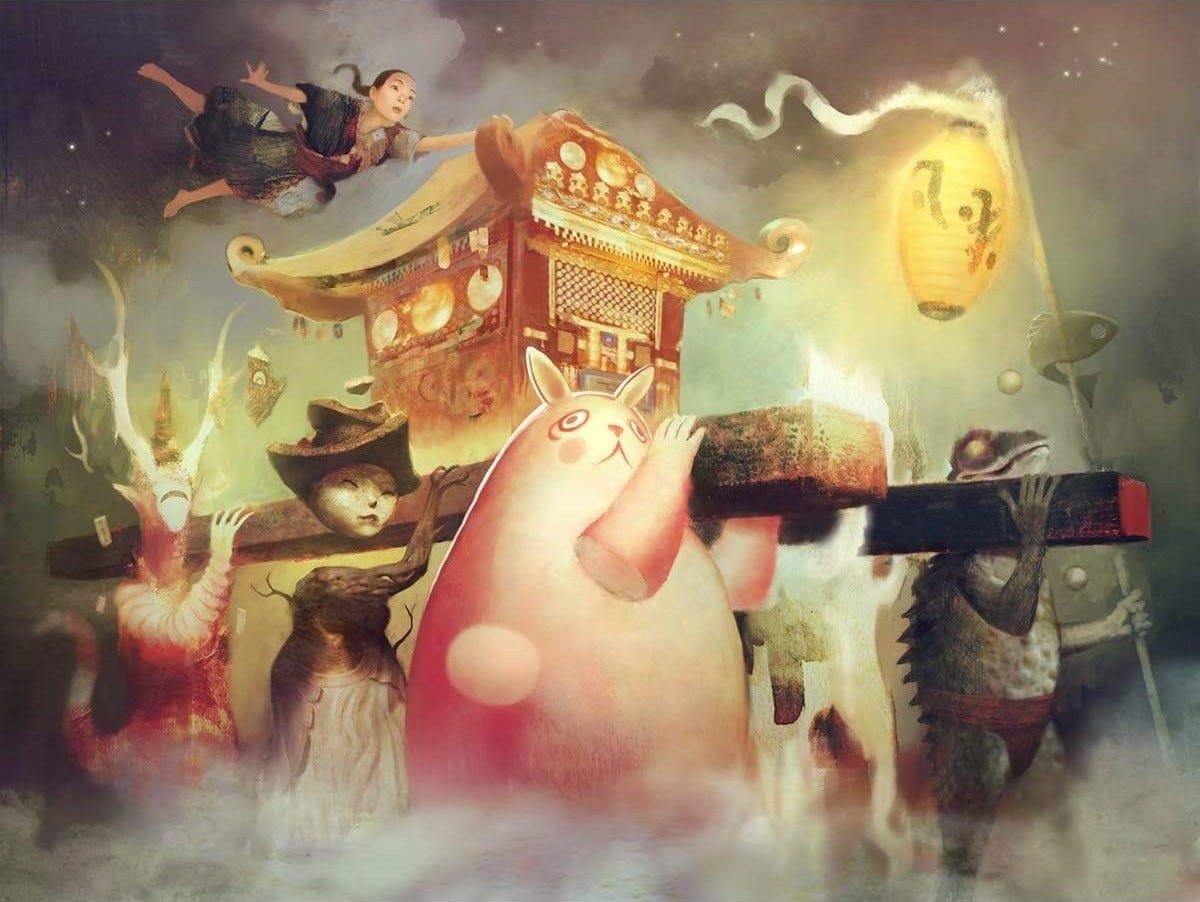
This essay’s “unrelated art that moves me” is Nils Hamm’s March of Otherworldly Light, from the 2022 Magic the Gathering set Kamigawa: Neon Dynasty.
I wish I was more like you, I'm one of those other publishers you mention.
"the publishing industry typically attracts people who love books. Publishers, editors, press founders, poets, language practitioners—these are people who think about the meaning and importance of words, the kids who got high grades in languages but not necessarily in physical sciences or mathematics, and who are labelled ‘creative types’ by society and go on to study Humanities."
Doing the numbers and making them work is like entering another world - like in a sci-fi novel, I have to go through a portal and focus and concentrate in a way I don't have to in the rest of my work/life. And as soon as I leave that alternate world, I "forget" the ways and culture, as though it was a dream.
Thank you, dankie, Marius!