On Cutting
Or, killing those darlings

A big part of my professional life as a publisher involves asking other people to cut things they love.
This is of course not the language used when talking to authors. We “tighten”, “shape” and “find the spine of the book”. We use language that makes the work sound surgical and benign. But what we are doing, almost always, is identifying the parts of a manuscript the writer is most attached to and explaining why those parts must go.
It is a strange and specific kind of negotiation. The writer has typically spent months, sometimes years, building the very thing you are now suggesting they remove. They love it for reasons that are not always commensurate with the page. They love it because of what it cost them, or what it represents, or what it says.
For most of my career, I have been the person sitting on the other side of the cutting conversation. I had thoughts about cutting. I had techniques. A defensible philosophy, even.
And then I started writing my own novel.
Vespers of Tassari, the epic fantasy book I am writing, has existed in one way or another for about six years. I have written, by now, considerably more text than will appear in the finished book. There are scenes that no longer exist (well, they still exist - in my “removed scenes” folder). There are characters I sketched for entire arcs that, somewhere in revision and rewriting, simply vanished. There are structural elements I built carefully and then, on later inspection, found I could not keep.
This essay is about cutting. Not about revision in the larger sense - clarifying, deepening and restructuring all involve a great deal of additive work - but specifically about subtraction. About the moments where you decide that something which exists, which is in many cases working, which you may genuinely love, must nevertheless be removed.
It is, to me, the hardest part of writing a novel. It is also, I have come to believe, the part that actually makes your manuscript a novel.
The publisher’s eye, turned inward
The asymmetry between publisher-me and writer-me became apparent very quickly. As a publisher, I have a clear and almost ruthless instinct for the cut. I can see, often within a first reading, where a manuscript carries weight it does not need. I can identify the chapter that exists for reasons of authorial attachment rather than narrative function. I can articulate, with something close to confidence, why a particular subplot is asking the reader to care more than the book has earned.
When the manuscript is mine, none of this works.
Or, more precisely, all of it works - but with a painful lag. I can look at a scene I wrote and know, intellectually, that it should not be there. I can name structural reason. I can outline the consequence of removing it. And then I will sit with the file open for an afternoon, sometimes for several days, before I am actually able to delete it.
The publisher’s eye does not become useless; it just becomes slower, and obstructed. Something between the seeing and the doing intervenes that does not exist when the work belongs to someone else. That something is, of course, ownership. This novel is a thing I have been making, alone, for years. Every paragraph carries the residue of the late night it was written. Cutting it is, in some small way, cutting that late night out of my life.
This is an indulgence I would not tolerate from any author at Mirari. it is, for the writer, almost unavoidable. Recognising it for what it is - sentimental rather than structural - is the first step toward being able to cut.
What writers love versus what the book needs
These are different things, and the conflation of them is the central problem of revision.
A writer’s attachment to a passage is not random. It typically tracks one of three things: the difficulty of producing it, the personal importance of its content or the perceived quality of the prose itself. All three are legitimate as feelings. None of them is, by itself, evidence that the scene or passage belongs in the book.
A former colleague told me once that her driving principle is always to ask ‘what is best for the book’. This is such a profound question. When we prioritise the book above the author, characters, editor, publisher, marketer and even reader, we understand that there are decisions that need to be made that will rile one or all of the stakeholders.
A book has its own needs. Sometimes to make a book better the author must let go. Sometimes the publisher must concede a point. Sometimes the editor must bite their tongue. Can we, together, put aside personal wants, needs, preferences and opinions and concede that this specific book will benefit from a decision we do not like?
Structurally, we must ask: does this passage move the argument of the novel forward? Does it earn its space against the pressure of what comes before and after? Does it deepen, complicate or sharpen what the reader is being asked to hold? If the answers are no, the passage does not belong, regardless of how it was made or what it cost.
This sounds simple. Dearest gentle reader, it is not. The reason it is not is that the writer’s attachment is, in the act of reading, almost indistinguishable from the passage’s apparent quality. Of course the chapter that took six months to write feels like the best chapter in the book - you know it more intimately than any other. Of course the scene that names something true feels weightier than the scenes around it - it carries weight you put there. The page does not know the difference between a passage that is genuinely earning its place and a passage that the writer cannot bear to lose. Only structural analysis, performed against the writer’s own resistance, can tell them apart.
The iceberg, in reverse
In an earlier essay I wrote about the iceberg principle: that a writer should know much more about their world than ever appears on the page. Tolkien knew the linguistic history of his characters’ names. Le Guin knew the cultural assumptions encoded in Gethenian biology. The reader feels this depth even when nothing of it is explicitly stated.
What I did not say in that essay is that the iceberg is not only a matter of what you know. It is also a matter of what you wrote and removed.
The submerged mass beneath the surface of a novel is not abstract knowledge. It is, very often, actual prose. Pages and pages of scenes that were drafted, refined, sometimes polished to the point of near-publication, and then taken out. Backstory written in full and then compressed into a sentence. Subplots developed across multiple chapters and then reduced to a single suggestive line. Characters who once had viewpoint chapters and now appear only in passing.
This material does not vanish. A character who was once a POV figure carries, even in a small role, the weight of their unwritten interiority - the writer wrote them from the inside, and that interiority surfaces in the small choices, the gestures, the way other characters speak about them. A subplot that was cut still leaves its tonal residue. The world feels populated by what is no longer named.
This is, I think, what readers respond to when they describe a book as lived-in. It is not depth that was conjured at the surface. It is depth that was once written at length and then withdrawn.
The implication is uncomfortable but useful: a great deal of what makes a finished novel enjoyable is work that the reader will never see, because it does not exist anymore.
The cut as a structural decision
It is tempting to think of cutting as a negative act but in many ways it is the creation of opportunity. Every cut reshapes the surrounding text. A scene removed creates a gap; the gap must be addressed. A character cut requires the redistribution of their function across the cast that remains. A subplot removed alters the rhythm of the chapters around it.
Cutting well, then, is not a matter of identifying weak material and excising it. Weak material is the easy case; cutting it is editing, not surgery. The harder case is identifying material that is functioning but whose function the book does not, on closer inspection, need. That kind of cut requires you to consider not what the passage is but what it is doing, and whether the work it does is work the book needs done.
In the drafting of Vespers I learned, slowly and somewhat painfully, that I had a tendency to write scenes which were, individually, well-shaped, atmospheric, sometimes affecting (early readers’ words, not mine!) but whose work was redundant with work done elsewhere. Two passages, separated by chapters, doing the same emotional or structural job. The fact that both were good was the trap. Both were, in isolation, defensible. The book did not need both.
Recognising this was a slow business, and required external help - readers I trust who at various points have said some version of “this is good, but you don’t need it.” That sentence is much harder to hear than “this isn’t working.” The cut, when it came, was a structural decision: which version does the work better, and what does the other version’s removal allow the surrounding text to do?
This is, I think, the deepest discipline of revision. Not removing the bad, but choosing between the good. Knowing that a passage’s quality is not, in itself, an argument for its survival. The book is not a collection of strong passages; it is a structure, and the structure is what the cut is in service of.
What survives
A finished novel is not the sum of what was written for it. It is the residue of what survived a long sequence of decisions about what could not stay.
This is, I think, why cutting is so often experienced as loss. The writer feels the cuts; the book does not. To the reader, the book simply is what it is: a structure of decisions whose alternatives are invisible. To the writer, every page is shadowed by the pages that are not there. The completed book is, in a real sense, made of absences.
What I have learned, over many years of slow revision, is that this is in many ways the work. The novel I am writing is not the novel I started writing; it is what survived the cutting. The novel I will publish will not be the novel I currently have; it will be what survives the cutting still to come.
The discipline of finishing a book is the discipline of being willing to cut. The willingness to cut is not, as I once thought, a hardness. It is a kind of attention - an insistence on noticing what the book needs, rather than what the writer wants.
Mine is being finished, slowly, by the things I am willing to take out of it.
ARS CULTURA
Here’s what I’ve been reading and watching.
Books
Having finally caught up on The Handmaid’s Tale earlier this year, I have now devoured The Testaments. I expected an extended postscript and found a counterargument. Atwood gives the regime three voices instead of one, and the moral architecture of Gilead becomes something you can walk around inside rather than peer at through a keyhole. Aunt Lydia alone justifies the book’s existence. The pleasure of a sequel that genuinely earns its place is rare. This is one.
For fans of: dystopian fiction with consequences, the long memory of regimes, the satisfaction of a sequel that justifies itself.
I am roughly twenty percent of the way into Paul Murray’s The Bee Sting — too early to commit to a verdict, but already deep enough to recognise the kind of book it is: a long Irish family novel that takes its time, asks for patience, and seems to be quietly arranging the conditions for something terrible. More on this when I surface.
For fans of: Irish family sagas, slow-burning dread, novels that trust you to wait.
Movies
I did not finish Outcome (2026), Apple TV+’s Jonah Hill vehicle for Keanu Reeves, and I do not say that lightly. It is the worst film I have attempted in years - tonally confused, dramatically inert, and oddly self-pitying. Not even Martin Scorsese in a supporting turn could pull me through. Save the evening.
I rewatched Peter Jackson’s Hobbit trilogy (yes, all three; yes, the extended editions) and was, against all critical orthodoxy, completely happy. I am aware of the irony of confessing this in the issue I just spent writing about cutting. Some excess, evidently, I forgive. Bilbo on his birthday morning, the dwarves at Bag End, the riddles in the dark - these films give me a pleasure I cannot defend in publishing terms, and I am at peace with that.
Against my expectations, The Devil Wears Prada 2 turns out to be a serious commentary on AI and the value of human-created work. It is not a perfect film. But the conversation it is having - about magazines, about taste, about the slow displacement of human craft by machines that mimic it - is more substantial than a twenty-years-later sequel had any right to be. I have thought about it more than I expected to. Streep, of course, remains Streep.
Art
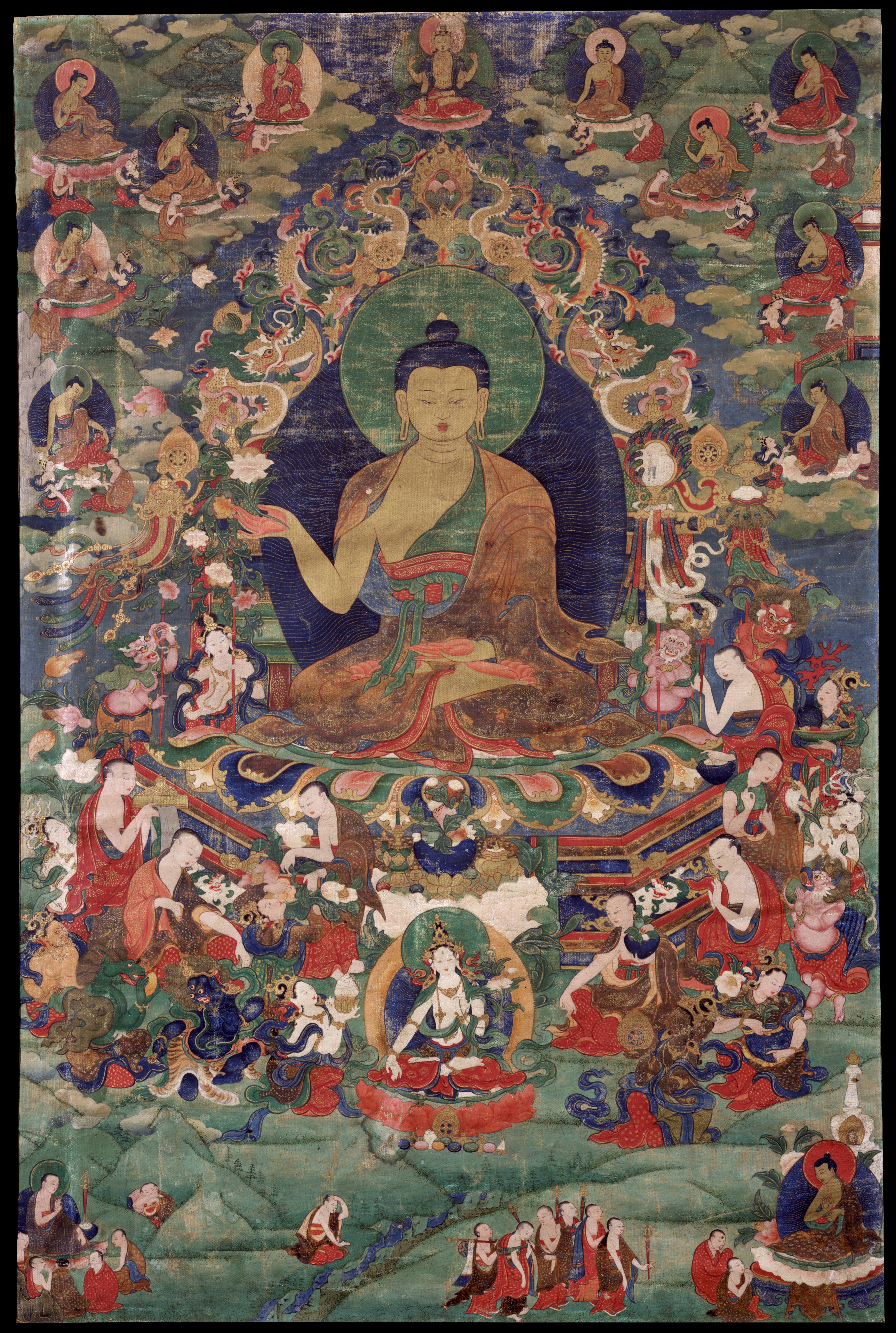
This essay’s “unrelated art that moves me” is Shakyaumuni Buddha by an unknown artist, from the 18th century.