
On Forms
Or, the importance of imprints and lists.

I wanted to be an editor at Bloomsbury. I first came across the press during a torrid affair with English Literature 201 while reading Virginia Woolf, and was overcome with a desire to be part of such an illustrious, albeit obscured, institution.
Never you mind that Bloomsbury Publishing has nothing to do with Woolf’s Bloomsbury Group. The point is, I was enchanted by the knowledge that there are companies that have a clear cultural point of view, a set of guidelines that inform what they produce and why, and that they do it mostly from the shadows. I had finally discovered trade publishers, after staring at their logos for the majority of my life. I knew where I needed to be.
This issue is about the structure of trade publishing: what kinds of publishers exist, what an imprint actually is and what a list actually is.
And because this is a newsletter about hidden things made visible, I want to add one more layer: the way publishing talks about itself. Not just the jargon, but the deeper assumption that language can neatly capture value. That the industry can take something as slippery as taste and translate it into something as rigid as a financial forecast. In other words: the old philosophical problem of turning messy human experience into categories.
Plato would’ve had a field day.
The kinds of trade publishers (or: the ecosystem, briefly)
One of the reasons publishing feels so hidden is because people assume it’s a single entity: Publishing, capital P, like it’s a country or something.
The thing is, Publishing isn’t a singular thing. I like to think of it as an ecosystem with distinct, separate components – all of which add up into the business of books. So, here are some of those components.
At one end you have the conglomerates: the giants most people vaguely recognise (Penguin Random House, Pan Macmillan, etc.). They have enormous backlists, global distribution, and enough internal departments to make you wonder whether they’re publishing books or running a greater metropolitan area. Their strength is scale. Scale gives you reach, bargaining power, and infrastructure. Scale also gives you bureaucracy and a certain allergy to unpredictability.
Then there are the large independents, big enough to have serious reach, small enough to retain personality (like Bloomsbury, W.W. Norton and Faber & Faber). These publishers can feel, from the outside, like “real publishing,” because they often manage to balance commercial pragmatism with editorial conviction.
Then you have small presses. This includes names like Fitzcarraldo Editions, Tilted Axis Press, my own Mirari Press, and Modjaji Books. These are frequently misunderstood as miniature versions of big publishers. They aren’t. Many small presses operate on a different logic entirely. Their identity is often sharper. Their survival depends less on dominating shelf space and more on building trust with a particular kind of reader. Sometimes they’re the ones doing the cultural work that later gets absorbed and monetised by larger institutions.
The key thing to understand is that these aren’t just different “sizes” of publisher. They’re different business models. They behave differently because they have to.
You’ll notice that I am excluding self-publishing here. For this essay I am focussing on the traditional publisher – future editions will look at self-publishing, its perks and its risks. Stick around.
Plato and the fantasy of the “ideal publisher”
Plato had this idea that behind the chaotic world of everyday objects there are perfect versions: Forms. The perfect circle, the perfect chair, the perfect justice. Reality is just an imperfect shadow of these ideals.
Publishing is full of its own Platonic Forms.
There is, somewhere in the industry imagination, an ideal book: brilliantly written, culturally important, universally adored, and (crucially) commercially successful. The sort of book that wins prizes and sells in the millions of copies. The kind of title1 that lets everyone in the building feel like a patron of the arts and a competent businessperson at the same time.
And there is, too, an ideal publisher: tasteful, principled, bold, culturally significant, but never reckless. A curator with perfect judgement and perfect timing.
In reality, publishing is not the pursuit of perfect Forms. It’s the management of imperfect objects in imperfect markets. Which is why the industry is constantly translating reality into abstractions (lists, imprints, “the market”) so it can behave as though it’s dealing with ideals rather than uncertainty.
Imprints
It’s really useful to understand what an imprint is, and what it isn’t, when thinking about publishing. An imprint is a publishing brand within a publishing house, usually with its own editorial identity, taste profile, and market positioning. To readers, it looks like a logo. To the industry, it functions like a promise: this is the kind of book we publish, and this is the kind of book we don’t. Imprints make books legible to booksellers and agents, help publishers target different markets without diluting their identity, and give internal teams a coherent set of priorities to acquire and publish around. In practice, an imprint is less a decorative mark and more a strategic container for taste.
Here Wittgenstein is useful. He argued that meaning isn’t something a word contains, but something it does. Meaning is use. An imprint’s meaning is not its mission statement, or the aesthetic of its logo, or the vague claims it makes about “championing voices.” The imprint’s meaning is what it actually acquires, what it actually rejects, and how it is treated by the rest of the trade. Imprints are language in action: a way of saying “this belongs” and “this does not.”
I’ll give you an example. Mirari Press has three imprints at the moment. Our main imprint publishes full-length genre fiction novels. A second imprint with its own name (Mirari Revel) publishes queer short stories as ebooks only. A third imprint, AIUR, publishes Earth-focused fiction and non-fiction. Each imprint is still part of the same publishing house, while retaining its own identity and list.
Lists
Speaking of. List is another word you’ll come across often when engaging with the industry. A list is the selection of titles a publisher or imprint commits to publishing over a given period, and it is both a creative statement and a financial plan. It reflects what the publisher believes in, but also what the publisher can afford: editorial attention, marketing spend, sales focus, and production capacity are finite resources, so the list becomes the place where ideals meet limits. This is why “fit the list” has such power in publishing: because it often means not only is this good? but can we sell this through our channels, with our identity, using the resources we have?
If imprints are a publisher’s identity, lists are its behaviour.
Let me sneak in a third philosopher here. It’s relevant, je promets. Kant argued that we do not encounter reality “raw.” We perceive the world through categories – structures of understanding that shape what we can even recognise as an object in the first place.
Publishing works like that. A book does not arrive in the industry as pure art, but rather as something that must be made intelligible: a genre, a category, a comp set, a target reader, a price point. The list is where a manuscript becomes an object the industry can see.
The list is also often why a book is not picked up by a publisher. To go back to the Mirari list: we only publish speculative fiction. So we will necessarily decline a really, really, really good crime thriller. It simply wouldn’t “fit the list”.
Why all of this matters
If you take nothing else from this essay, take this: publishing’s language and structure are shaped by its risk model.
Imprints exist because identity reduces uncertainty. Lists exist because resources are finite. And jargon exists because uncertainty needs to be managed quickly, in rooms full of people who are trying to turn taste into numbers without admitting how strange that is.
Wittgenstein would tell us to look at how the words are used. “Fit the list” doesn’t mean “this is bad.” It often means “this cannot be processed by this organisation without taking a risk it cannot justify.”
Kant would tell us that the categories come first – that you can’t even perceive the object until it’s been shaped into something recognisable. A book becomes legible only once it has been turned into genre, market, audience.
And Plato would remind us that the industry is haunted by ideals: the perfect book, the perfect publisher, the perfect cultural artefact that also happens to sell.
Those ideals aren’t necessarily bad. They’re part of what makes publishing feel meaningful. But the work of ARS ARCANUM is to show the shadow behind the Form: the actual machinery.
Because once you see it, you can stop mistaking publishing decisions for divine pronouncements. You can stop hearing “the market doesn’t want this” as fate. You can recognise it for what it usually is: a human judgement, made inside a system, with costs attached.
In the next issue of AA I’ll move away from “publishing 101” content, and towards speculative fiction as a genre. I look forward to seeing you there – bring your dragons.
And no, I never made it to Bloomsbury. Turns out I didn’t need to.
ARS CULTURA
Here’s what I’ve been watching, reading and listening to.
Series
We recently finished a rewatch of Schitt’s Creek, and I maintain that it is one of the most culturally significant pieces of media of the century. If you’re one of the five people who have not watched it yet, please do us all a favour and get with it. Eeeww David!
RIP Catherine O’Hara, who made the world fall in love with Moira Rose.
For fans of: feel-good comedy, ugly crying and Annie Murphy flicking her hair back.
Books
I finished The Burning God, the last instalment of RF Kuang’s grimdark fantasy The Poppy War trilogy. I’m happy to report that the series only gets better as you make your way through it. Nezha, Rin and Kitay will stay with me for a long time. And the ending – jesus. Brutal. Thanks Kuang!
For fans of: Chinese history and mythology, commentary on colonialism, burning everything to the ground
I also re-read two Mirari titles (one just released, one coming out later in February). Gary Hartley’s 4 VESTA is a short story about a queer stargazer and an asteroid heading for earth (and yes, you get to read from the asteroid’s POV too), and Catriona Ross’ The Which Word is a sexy urban fantasy set in Cape Town, with witches, sex and secret societies.
Movies
A rewatch of 2008’s Doubt reminded me exactly why Meryl Streep has her reputation. Amy Adams also continues to surprise. The sticky sense of unease the movie leaves, the questions you can’t quite answer, the doubt (come on, it was right there) makes it a perennial stand-out.
I was surprisingly into Netflix’s Purple Hearts, a run-of-the-mill romance but with singing, Nicholas Galitzine and a beautiful golden retriever that doesn’t die!
Music
The Grammys were this Sunday and the music world is abuzz. I have nothing to say about most of the winners, as I have been on a bit of a reminisce. Lisa-Marie Presley’s Now What, Imogen Heap’s Ellipse and my gay icon Lana del Rey’s entire discography have been on repeat for a few weeks now. I can recommend all of these (give ol’ Lisa-Marie a try before you knock her).
Art
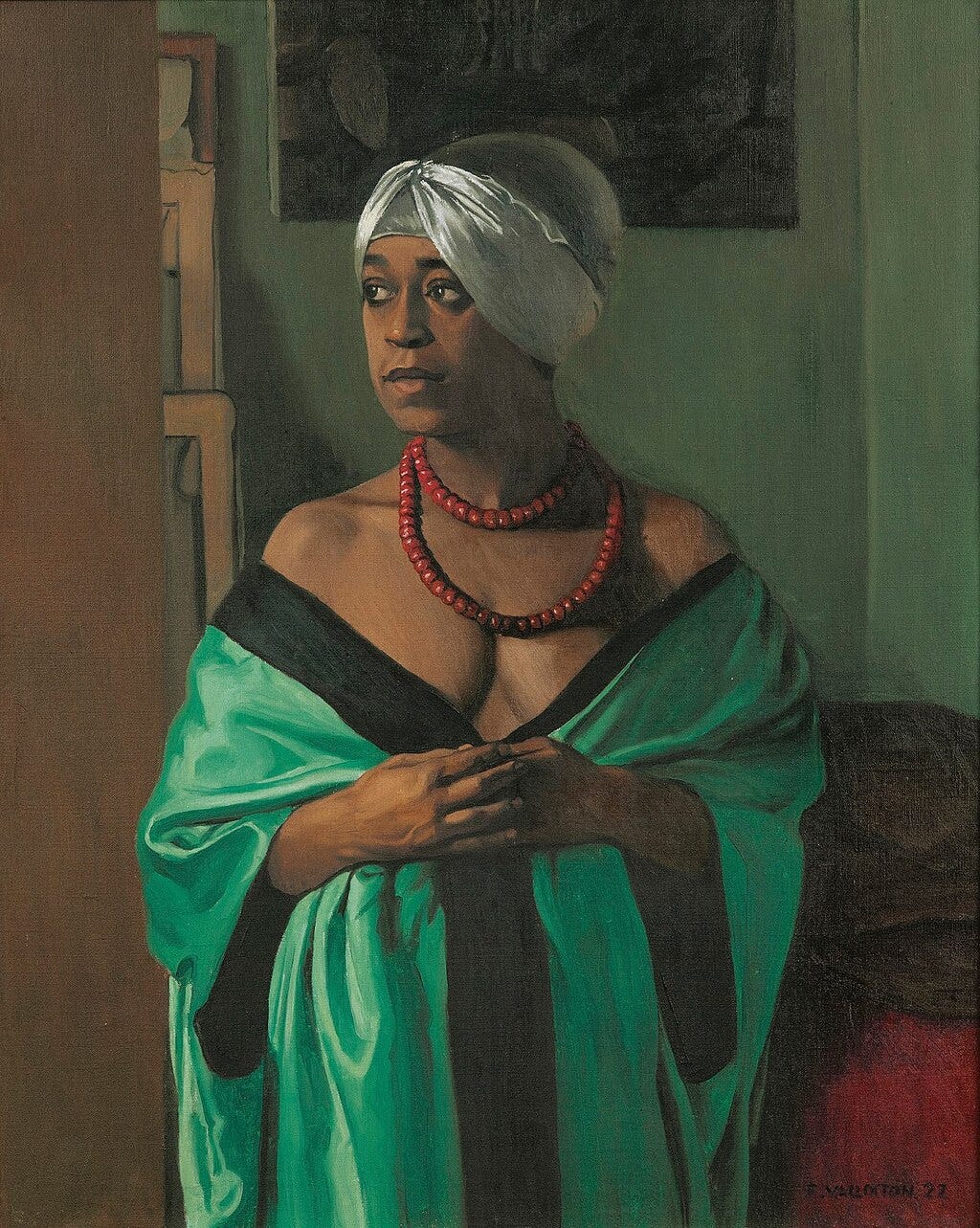
This essay’s “unrelated art that moves me” is Félix Vallotton’s Aïcha, a portrait of Aïcha Goblet, the model and dancer from the Années Folles.
Piece III: Aïcha by Félix Vallotton
Title is the publishing term for ‘book’. It refers to the content, and is less concerned with the format. So a title can mean the hardback, paperback, ebook, audiobook, all of these, or some of these.
Wow, the part about how publishing tries to operationalize taste into a financial forecast really got me thinking. How do they even begin to model something so subjective without losing its essence? Such a briliant observation!
This is so fascinating!!! I’ve been meaning to write something about imprints for years but you’ve done it so much more thoroughly and with a wealth of information that I couldn’t have. Love it.