
On Acclaim
Or, why we wait for London and New York to tell us a book is worthy.

Two weeks ago Mirari turned a whole two years old. So, I’ve been in a reflective mood. Something that keeps coming up for me is the added burden of “proving” that locally published books are good (whatever that means), and are worth the reader’s while (and money).
The thing is, there’s this question that I get asked all the time, everywhere I go, and whenever I talk about one of our books. It arrives at dinners, at launches, in the aisle of a bookshop when someone turns one of our titles over in their hands and reads the back. The book interests them. They have read the blurb twice. And then they ask, “but is it any good?”
I have learned to hear the word that goes unsaid. They are not asking whether the story or writing is good, or whether the book will be enjoyable. They are asking whether it is good for a local book. The same person will buy a debut by a midlist American author they have never heard of without a flicker of doubt, on the strength of a cover quote from a magazine they don’t read. The foreign unknown earns trust on sight. The local unknown has to audition.
The pattern is consistent enough to feel like a law of physics. Let’s call it The First Law of Outsourcing Opinion (I’m feeling a bit sassy today, can you tell?). South African readers (and South African institutions, and frequently South African writers themselves) withhold their full support from local work until that work has been validated somewhere else. A prize. A review in a London paper. A foreign edition with the foreign price sticker still on it. Until then the book’s quality is provisional. Afterwards, suddenly, it was always excellent and we always knew.
It would be easy to call this snobbery, or disloyalty, and leave it there. I don’t think that’s quite right. The behaviour is too widespread, too consistent, and too often displayed by people who genuinely love books, to be a simple failure of character. It is something closer to an inherited reflex – and like most reflexes, it is worth understanding before we decide whether to be ashamed of it.
The London hearing
In 1894 the Australian writer Henry Lawson noticed the same reflex in his own country. The local writer, he wrote, is received as an imitator – the Australian Kipling, the Australian Burns – branded a copy of someone real, by his own countrymen, who imagine they are flattering him. The moment that writer sails “home” to England and is noticed there, he is reintroduced to his own country by cable, as the well-known author who has lately attracted attention in London.[1] The country could not see him until London saw him first.
Half a century later the critic A. A. Phillips gave the reflex a name. In a 1950 essay he called it the cultural cringe: the ingrained assumption that whatever is made locally must be inferior to whatever is imported, and that the only route to esteem at home runs through the approval of the metropole. Phillips was writing about theatre, music, art and letters; the term has since been borrowed by Scots, Canadians, New Zealanders – by more or less anyone who has spent a few centuries being administered from somewhere else.
I raise it not to perform a diagnosis but because it is the most useful description we have of the machinery. The cringe is not so much a dislike of local work as it is a refusal to trust one’s own judgement of it. The cringing reader does not think the local book is bad; they think themselves unqualified to decide, and so they wait for a qualified authority to decide for them. That authority, by long colonial habit, lives abroad.
And it is not only readers. The reflex runs through the whole trade, including the part of it I sit in. South African writers chase the foreign agent and the overseas co-edition not merely for the advance but for the legitimacy the foreign deal confers back home. Publishers reach instinctively for the international comparison when pitching a book, because “the South African Le Guin” moves a manuscript into a room faster than any home-grown claim could. We have built an entire industry that agrees the real validation lives elsewhere, and then we are faintly surprised when readers behave as though it does. The cringe is not something the market does to us. It is something we all do together.
Five hundred copies
You know I love a number. So let’s get into it.
In 2020 a South African novelist named Karen Jennings published a novel called An Island. She had spent years trying to place it; by her own account she could not secure reviews, could not get blurbs, did not even have an agent. It was finally taken on by two tiny independents, Holland House in the UK and Karavan Press here, and printed in a run of five hundred copies. Those copies, in her own word, were met with silence. By the middle of 2021 the book had so completely failed to register at home that readers who went looking for it in Cape Town and Johannesburg bookshops could not find a copy on the shelf.
In August 2021 An Island was longlisted for the Booker Prize.[2] Within weeks Holland House had ordered a reprint of five thousand copies – ten times the entire original run – and foreign rights interest arrived from territories that had ignored the book for a year. A local literary site ran the story under a headline I have never quite shaken: that it took the Booker to introduce South Africans to their own Karen Jennings.
Sit with the mechanics for a moment. Not one word of the novel changed between July and August. The prose was identical. The themes were identical. The only thing that changed was the provenance of the judgement: a panel in London had announced that the book was worth taking seriously, and a country that had declined to form its own opinion gratefully adopted theirs. The five hundred copies were the measure of what we thought of the book when the decision was ours to make. The five thousand were the measure of what we thought once someone else had made it.
The economics of a borrowed opinion
If the cringe were only a psychological defect we could shame people out of it. It isn’t, quite. It is also a rational response to a thin market, and that is the part that should interest those of us who make books here.
Forming an independent judgement of a book is expensive. It takes time, attention, and a working critical apparatus to lean on: review pages, prize ecosystems, trusted booksellers, a literary conversation dense enough that a reader can triangulate a book’s worth before committing R350 and several evenings to it. In a large market that apparatus is thick. A reader in London or New York is standing inside a weather system of signals, most of them invisible, all of them doing the work of pre-selecting a book for a reader (I can’t help but think of Miranda Priestley’s ‘cerulean’ monologue here).
In South Africa the apparatus is thin, and getting thinner. Newspaper book pages have shrunk to almost nothing. The local prize ecosystem is small and chronically underfunded. Literary coverage is scattered across a handful of sites and a great deal of unpaid goodwill. A reader standing in a bookshop holding an unfamiliar local novel genuinely does not have much to go on – and so, sensibly enough, they reach for the one signal that is cheap, abundant and pre-validated: the foreign imprimatur. The Booker sticker is doing the work that an entire critical culture does elsewhere. It is a heuristic for a country that has been left to improvise its own literary infrastructure.
This reframing matters because it tells us where the lever actually is. The cringe is not undone by exhortation – by telling people to be prouder, to buy local, to believe in the work. (That is precisely the motivational register that never moves anyone.) It is undone, slowly, by building the local signals that make an independent judgement cheap enough to risk. Every functioning review outlet, every credible prize, every bookseller willing to stake their own taste on a local title, lowers the price of having one’s own opinion. The cringe is, at bottom, an information problem wearing the costume of a character flaw.
What it costs the press
For a small publisher the cringe is a bit more than a simple abstraction, or a philosophical point to debate. It is, very much practically, a cash-flow problem.
I have written before about the arithmetic of a single title — the break-even maths that means a Mirari book, printed in a tranche of three hundred copies, has to sell most of that run before it returns a single cent of profit. Now lay the cringe over that arithmetic. The validation that would unlock local demand, if it comes at all, tends to arrive after the relevant print run is exhausted and the book has been written off. Jennings’s five hundred copies were gone before the Booker called. The reprint the prize justified was a second, separate act of faith – and most books, and most presses, never get a second one.
This is the cruelty of the sequence. Foreign acclaim, when it lands, lands late. It validates work the local market has already declined to fund, and it does so on a timeline that rewards the foreign reprint far more than it ever rewarded the press that took the original risk. We are asked to underwrite the discovery, and then to watch the credit, and frequently the rights, migrate north.
And notice which books the escape hatch is built for. The prize that rescued Jennings rescues literary fiction; it has almost nothing to say to genre. A speculative novel published here cannot wait for a Booker, because the Booker was never going to come – the international validation that eventually corrects the market’s verdict on serious literary fiction simply does not exist, in any comparable form, for most of the books I publish. For local genre fiction the cringe has no second act. There is only the home market, deciding or declining to decide, the first time and the only time. Which means the readership we are arguing for is not a nicety. For a speculative-fiction press in this country, it is the entire mechanism of survival.
So when a reader asks me whether a Mirari book is any good, I have stopped hearing a question about quality. I hear a request to be relieved of the burden of deciding – a hope that some larger, more distant authority will step in and take the risk of holding an opinion, so that the reader doesn’t have to.
That is what the wait for acclaim actually is. Not taste, and not even snobbery, but judgement outsourced: a habit of treating our own opinions as provisional until a foreign panel certifies them. The work of a South African press, then, is persuading a country to trust its own verdict before London hands one down.
Once you see the wait for what it is, you can no longer mistake it for discernment. The book in your hands is either good or it isn’t, and a longlist in another hemisphere will not change a word of it. The only question worth asking is whether we are willing to be the ones who decide for ourselves whether local literature is worthy, or whether we’ll keep on waiting for England and America to tell us what to like.
ARS ARCANUM
Here’s what I’ve been reading and watching.
Books
Since we have spent the whole of this issue on the subject of local books, it would be perverse to start anywhere else. Tanya Meeson’s The Witch of Benbar’s Cross is a Cape Town speculative novel – Meeson also runs Otherworld, the local spec-fic gathering – and it is precisely the kind of book the essay above is arguing for. Morgan Cadogen’s twin sister Juliet vanishes in a half-deserted desert town at the far end of the world, chasing a theory about shamanism; when Morgan arrives, the few locals left insist Juliet was never there at all. What follows is a slow, dread-soaked unspooling toward a truth – and a price – that Morgan never sees coming. Five stars. Read it before the rest of the world gets around to telling you that you should.
For fans of: missing-sister mysteries, eerie desert towns, women’s grief sharpened into rage, delicious witchy vibes.
I also finally went back to The Odyssey, and reader, the canon is canon for a reason. Three thousand years on, the story of a man taking the longest and most ill-advised route home while everyone who loves him pays the bill – gods meddling, crews drowning, a wife out-waiting an entire palace of freeloaders – is still a riot of a time. Five stars, obviously. I am not going to be the one to dock Homer. I will however say that Odysseus is all the proof we need that protagonists don’t have to be good guys, or likeable. What an idiot.
For fans of: Circe, Madeline Miller, men who really should have just gone straight home, nostos.
And at Mirari we have just launched UTOPIA/HAVOC. It’s our second short story anthology, and is themed around cyberpunk and solarpunk futures. My own story, Paper Lantern Boys, is also included. Grab a limited edition copy on our website here.
Movies
War Dogs (2016) is Todd Phillips doing his best Scorsese-lite: two twenty-something Miami chancers bluff their way into a $300-million Pentagon arms contract, mostly on nerve and Jonah Hill’s genuinely unsettling laugh. It is slick, queasy and a little hollow; a true story told with rather more swagger than conscience. But Hill and Miles Teller are good company for two hours. 3.5 out of 5.
I have also embarked on the completist’s pilgrimage: rewatching the entire MCU in in-universe timeline order rather than release order, which means opening in 1943 and pretending I don’t already know how every thread resolves. I have just reached Captain America: The Winter Soldier, still the best of the lot by some distance – the one film where the franchise briefly remembered it could be a paranoid 1970s political thriller with a conscience, Robert Redford and all. Next up: Guardians of the Galaxy.
Art
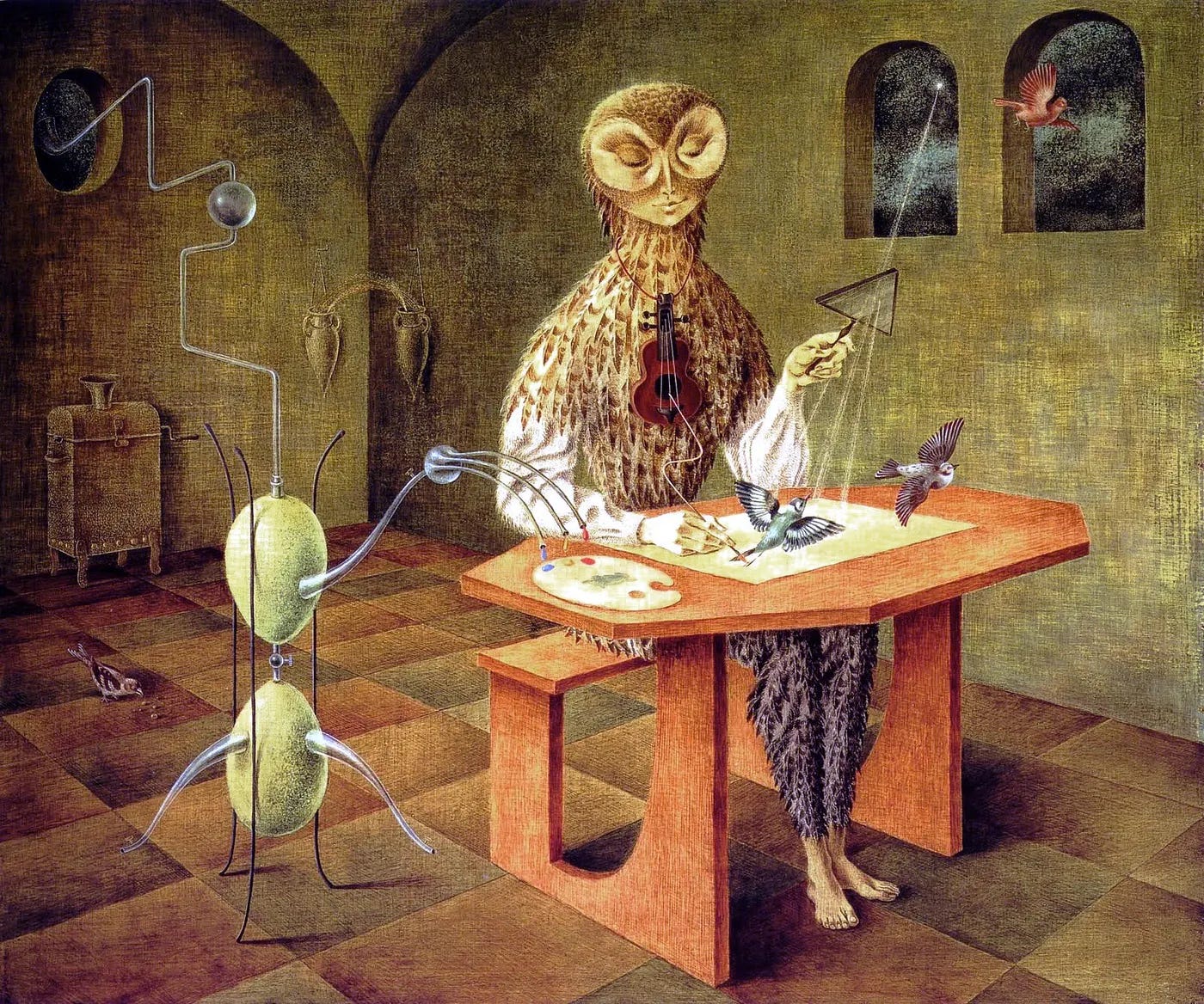
This essay’s “unrelated art that moves me” is Creation of the Birds by Remedios Varo. An owl-headed figure sits alone at a desk, drawing birds that lift off the page and fly out into the world – the brush running from a small violin at her chest, the light guided down through a prism, the pigments distilled from an alembic on the wall. Varo, a Spanish surrealist who fled the war and did her real work in exile in Mexico City, painted this kind of figure as a maker of worlds. I can think of no better picture of what it is to sit at a desk and try to coax something living out of nothing at all.
[1]Henry Lawson, preface to Short Stories in Prose and Verse (1894). The full extract: The Australian writer, until he gets a "London hearing," is only accepted as an imitator of some recognized English or American author; and, as soon as he shows signs of coming to the front, he is labelled "The Australian Southey," "The Australian Burns," or "The Australian Bret Harte," and lately, "The Australian Kipling." Thus no matter how original he may be, he is branded, at the very start, as a plagiarist, and by his own country, which thinks, no doubt, that it is paying him a compliment and encouraging him, while it is really doing him a cruel and an almost irreparable injury. But mark! As soon as the Southern writer goes "home" and gets some recognition in England, he is "So-and-So, the well-known Australian author whose work has attracted so much attention in London lately"; and we first hear of him by cable, even though he might have been writing at his best for ten years in Australia.
[2]On the same 2021 longlist sat Damon Galgut’s The Promise, which went on to win the prize outright. Two South Africans on the list – both, in effect, left to the British to discover on our behalf.
Read this Brittle Paper piece for more information on Jennings’ journey.
Thank you for putting this out there, Marius. It has long been my contention that a local writer has to score big overseas - or consistently over a long period be published there - before locals will buy that writer's book. And, you're spot-on about genre writers - who even knew there were local crime, sci-fi, YA, fantasy, dystopian novelists until a few years ago!
Thanks for writing this, Marius! (Many positive comments about this post in our writers' group, btw!) Here's an anecdote from about ten years ago: I was invited to say hi to a bookclub I had previously belonged to. The woman who had bought the books for that month had included some SA writers. The gist of a comment from one of the members of the club (who knew I'd been published here) was - I kid you not - "Why are you wasting money on South African writers?" A real chopped liver/boerwors moment. Mairexx