
On Dandelions
Or, the persistence of the book

Do people still buy books?
This is the primary refrain when I tell someone I work in publishing. It’s an important question to ask – if you are to hook the wagon of your financial survival to a horse, best be sure the horse is alive (forgive the hacked metaphor).
Last week I attended the Franschhoek Literary Festival (FLF) – a storied weekend-long affair in the Franschhoek valley, the town awash in the golds and deep ambers of autumn, lambent sunlight dappling through the oak leaves, the poplars standing sentinel against the threat of icy winter.
FLF is an interesting beast. It draws sharp criticisms and lofty praise. People are rarely impartial to it. Criticisms include lack of diversity, focus on non-fiction, too much politics, pretentiousness. Praise circles around community work through the FLF schools programme (a wonderful initiative that stocks local underfunded schools’ libraries and inculcates a reading culture in the farming communities of the area), access to international authors (the 2026 lineup included the likes of Alka Joshi, David McCloskey, Peter Frankopan, Rémy Ngamije, Sam Dalrymple and Tan Twan Eng) and the textured enchantment of the town itself.
I’m not interested in providing yet another take on the festival. I’m interested in, you guessed it, numbers.
I’ve written before about the importance of mathematics and data in publishing. The numbers provide something that our opinions, feelings and criticism cannot: things that are objectively true.
The CEO of Exclusive Books shared some interesting data with us at the launch event of FLF. Before I tell you, I want you to guess something:
What is the annual turnover of trade books in South Africa from 1 May 2025 to 30 April 2026? In other words, how much money do you think South Africans spent buying books that were not school or university textbooks?
Do you have a number? Lovely. Keep it mind - we’ll get back to it in a bit. First I want to talk about something truly riveting: the South African economy.
The economy
The South African economy is, by most measures, difficult.
The official unemployment rate sat at 32.7% in the first quarter of 2026, according to the latest Quarterly Labour Force Survey from Stats SA. Among those aged 15 to 24, the rate climbed to 60.9%. The expanded measure of labour underutilisation, which includes discouraged workseekers, stood at 43.7%. Roughly one in three working-age adults cannot find formal employment. Two in three young people looking for work cannot find any.
The wage picture is similarly stratified. The average gross monthly salary in 2025 was around R29 290. The national median, however, sits closer to R5 400. The gap between those two figures tells you almost everything you need to know about income distribution in South Africa: a small upper tail pulls the average upward, while most working South Africans earn far below the headline number.
Set this against the cost of a locally published trade book at R350 (RRP, our worked example from On accounting in Sumeria). That single book represents roughly 6.5% of the median monthly wage. Books in South Africa, even before we discuss anything else, are expensive.
Reading
If the economy frames the financial conditions of book buying, education frames the cultural ones. Here the numbers are bleaker still.
The 2021 Progress in International Reading Literacy Study (PIRLS), released in 2023, found that 81% of South African Grade 4 learners could not read for meaning in any of the country’s eleven official languages. This is up from 78% in 2016. Of the roughly 1.13 million children in Grade 4 in 2021, 914 000 could not locate and retrieve explicitly stated information from a simple text. South Africa ranked last out of 57 participating countries, and recorded the largest decline in reading achievement of any country with comparable data from the previous cycle.
These figures are often met with a kind of fatigued resignation. They shouldn’t be. Data, of course, can only ever look backwards. It is our job to look forward, using this data as a point of departure. These figures describe a school system that, for the great majority of children moving through it, is not producing readers. The publishing industry cannot fix this. Schools must. But the industry inherits the consequences of it: a steadily contracting pool of competent adult readers, and a smaller pool still of competent readers who are also able to spend money on books.
Where the books are
Then there is the question of access.
The 2023 National Reading Survey, conducted by the Nal’ibali Trust in partnership with the National Library of South Africa, found that while 87% of South African homes contain some print material – a religious book, a newspaper, a magazine, a dictionary, a textbook – only 37% contain a single work of fiction or non-fiction. Sixty-three percent of homes, in other words, do not own a single novel, biography, or essay collection. Of homes with children under the age of ten, 65% do not own a single picture book.
The same survey found that the average price South Africans say they are willing to pay for a new book is R145. Set against the R280 to R420 retail range of a locally produced trade title, the gap tells us everything we need to know: most people are simply priced out, even when the will to read is there.
Public libraries should, in principle, close that gap. They were designed to. South Africa has approximately 1 880 public libraries spread unevenly across nine provinces, and they remain the only realistic access point to a book they do not have to buy for the vast majority of the population. And yet the share of book readers who report getting books from a library has declined sharply over two decades: from 48% in 2006 to 24% in 2016 to 17% in 2023. Libraries are still essential. They are also under-resourced, under-staffed, and increasingly unfamiliar to younger readers.
This is the ground we are publishing into.
The dandelion
Most of us were taught, as children, to think of the dandelion as a weed: persistent, common, slightly disreputable, faintly embarrassing in a manicured garden. What we were not taught is that the dandelion has one of the deepest taproots of any wild flowering plant. A single mature taproot can run a metre or more into the ground, drawing water and minerals from soil that other plants cannot reach. The visible bloom, that bright, dependable yellow, is the smallest part of the organism. The plant survives because of what is hidden beneath it.
Dandelions are also extraordinarily generous. A single flower head produces between 150 and 200 seeds, each carried on the wind to ground that other species have written off as inhospitable. They flower repeatedly through the season. They thrive specifically in disturbed soil – soil that has been broken, neglected, or compromised. Where conditions are most difficult, the dandelion is most at home.
I think about this often, in the context of publishing here.
By every metric that publishing professionals are trained to take seriously – disposable income, literacy outcomes, household book ownership, library use, retail price tolerance – the South African market should not sustain a trade book industry of any meaningful scale. The headline numbers do not predict survival, never mind growth.
And yet.
R1.9 billion
Remember the number I asked you to guess? Well. The actual, real number is R1.9 billion. Yes. The annual turnover of trade books in South Africa, from 1 May 2025 to 30 April 2026, was R1.9 billion.
In 2021, the equivalent figure was R1.4 billion. That is an increase of R500 million, roughly 36%, over five years in which the unemployment rate climbed above 30% and stayed there, in which Grade 4 reading scores collapsed to their lowest level in over a decade, and in which the cost-of-living pressure on the median household intensified rather than eased.
Books, against every reasonable prediction, are not dying in this country. They are blooming in the cracks.
Note: This figure excludes all sales not reported through Nielsen Bookdata. So, for example, it excludes all sales made directly through the Mirari Press website, all sales made by independent authors, all sales made at market fairs or expos, and excludes the entire second-hand book market.
Seven million books
Some quick arithmetic. R1.9 billion divided across an average sale price of roughly R270 per book, a reasonable figure once trade discounts, retailer promotions, sales, and lower-priced paperbacks are factored in, gives us approximately 7 million books moving through South African retail in a single year.
That is a substantial number. Roughly one book sold for every nine people in the country. If we narrow the denominator to working-age adults with sufficient disposable income to plausibly purchase a trade title, the ratio gets considerably tighter. South Africans, against the conditions laid out above, are buying books at a pace that surprises most people the first time they hear it.
But.
Where the money goes
The R1.9 billion is a single aggregate figure. It obscures a more interesting question: where, exactly, does that money go?
A book published by a US conglomerate, written by a US author, distributed into South Africa via a multinational supply chain, sold at R450 to a Cape Town reader: most of the value embedded in that transaction flows back across the Atlantic. The bookseller’s margin stays here. The author’s royalty does not. The publisher’s profit does not. The advance that funded the author’s writing was paid in another currency, in another year, against the projected sales of another market. South Africa is, in that transaction, a downstream consumer.
A book published in South Africa, written by a South African author, edited and designed by South African freelancers, printed locally, sold at R350 to the same Cape Town reader: every link in that chain is paid in rand and stays in the rand economy. The author’s royalty supports their next book. The publisher’s profit funds the next list. The editor and designer earn a living that allows them to keep doing work for other small presses.
A meaningful share of South Africa’s R1.9 billion in trade book sales flows out of the country every year. I do not know the exact percentage – no one I have asked seems to either – but anyone working in this industry can tell you it is significant. International fiction, particularly genre fiction at the commercial end, dominates the front tables of most chain bookstores. South African fiction has, historically, had to fight for shelf space against imports it cannot match on volume or marketing spend. And the local market, perhaps unsurprisingly, has long skewed toward non-fiction like political memoir, history, biography, and sport, leaving local fiction in a thinner stratum still.
A redirect, not a sacrifice
Here is the argument I want to make, plainly.
South Africans are already spending R1.9 billion on books each year. That spending is not in question. The question is what proportion of it stays here.
The proposition is not that readers should spend more, or read more, or feel guilty about the books they love. It is far simpler than that: of every five books you buy this year, consider whether one of them might be by a South African author, published by a South African press. That is a redirection, not a sacrifice. Your annual book budget remains untouched. What changes is the destination of a fraction of it.
The mathematics here are unforgiving in a useful way. If 10% of R1.9 billion shifted toward locally published South African work, the local industry would gain R190 million in annual revenue. That figure would not even register as a rounding error in a Penguin Random House quarterly. In our market, it would be transformative. It would fund advances. It would sustain mid-list authors. It would allow small presses to take risks on debut writers. It would rebuild the editorial and design infrastructure that produces the next generation of South African voices.
The books already exist. The writing, in many cases, is extraordinary. What is missing is the act of redirection.
Blooming
The dandelion does not negotiate with its conditions. It puts its roots down and produces what it can. The South African publishing industry has been doing the same thing for decades – through political transition, currency volatility, retail consolidation, a literacy crisis, and a global pandemic.
R1.9 billion is not a small number. R1.4 billion to R1.9 billion in five years, under these conditions, is not a small story. It is evidence that something here is alive, and growing, on ground that should not by rights support it.
What that ground asks of us, as readers, is a small piece of attention. The books are already being made. The flowers are already opening. The only question is whether we are willing to look down at our feet and notice them.
ARS CULTURA
Here’s what I’ve been reading and watching.
Books
I finally finished Paul Murray’s The Bee Sting, and it earns its reputation. A 650-page Irish family novel split across four points of view collapsing under the financial pressures of a failing motor dealership and the slower-moving pressures of everything else. What I admired most was Murray’s structural confidence: the way each voice arrives complete and disorienting, the way the book makes you wait, sometimes for hundreds of pages, before the geometry between the four perspectives resolves. It is a useful book for anyone writing multi-POV fiction (hello, me) – a masterclass in trusting the reader to hold disparate threads in suspension.
4/5. One star deducted for an ending that I am still arguing with myself about.
For fans of: Jonathan Franzen, slow-burn family novels, Irish prose at its driest.
It is with enormous pride that Mirari Press launches Nerine Dorman’s Call the Fire this month – available now at miraripress.com. Call the Fire is the first of a five-book adventure fantasy series: proof that South Africans can, and do, write on par with the best of the best in genre fiction.
I have also been deep in editorial work on UTOPIA / HAVOC, the Mirari short story anthology, which is now in the final pass. More on that closer to release.
Movies
Olivia Newman’s adaptation of Shelby Van Pelt’s Remarkably Bright Creatures arrived on Netflix this month, with Sally Field as Tova and Alfred Molina voicing Marcellus the giant Pacific octopus. The film is, like the novel, gentle and melancholic. Field is exactly right for Tova and the script resists the obvious temptation to over-explain the animal at the centre of it. I gave the book a 4/5 last year, and the film earns precisely the same score. Rare for an adaptation. Rarer still that the rounding goes in the right direction.
For fans of: A Man Called Otto, Marcus the octopus from My Octopus Teacher, crying at unexpected moments.
In a less reputable mood, I have been rewatching the great disaster movies of the early 2000s: Roland Emmerich’s The Day After Tomorrow (2004) and 2012 (2009), both of which remain, against any reasonable critical defence, deeply enjoyable. 2012 in particular contains two of the most indelible images in the genre: the impossible tsunami breaching the Himalayas, and the Buddhist monk on the high temple steps, calmly ringing the great bronze bell as the wave arrives. He keeps ringing. The bell keeps sounding. Then the water takes everything.
For fans of: end-of-the-world spectacle, John Cusack outrunning physics, the slightly embarrassing pleasure of watching landmarks collapse.
Art
This essay’s “unrelated art that moves me” is by Maggie Laubser, one of the great South African modernists. Born in 1886 on a wheat farm called Bloublommetjieskloof in the Swartland, Laubser studied in London, the Netherlands, and Germany, where she fell under the influence of the Expressionists. When she returned to South Africa she was met, for years, with derision: her work was too strange for a conservative local audience, her colour palette too unruly, her subjects – Black farmworkers and rural Cape women – too apparently humble to count as serious art. She painted anyway. By the time she died in 1973, at her home Altyd Lig (“Always Light”) in the Strand, she was recognised as one of the most quintessentially South African painters of the twentieth century. Her catalogue raisonné contains 1,784 works.
The piece I want to share is Annie of the Royal Bafokeng (1945) – a portrait, painted from memory, of a young Black woman rendered with the kind of expressive clarity Laubser’s critics had spent two decades calling unserious.
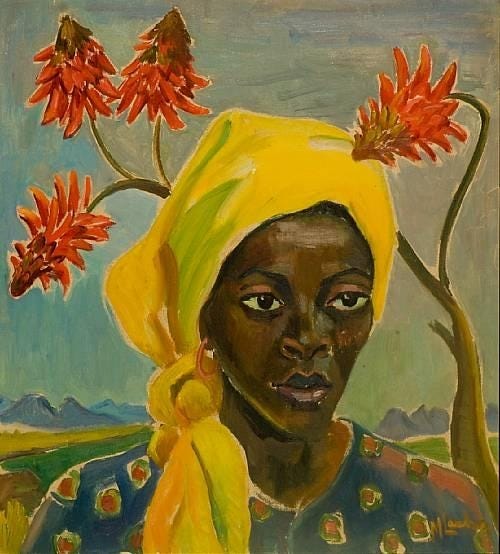
Piece VII: Annie of the Royal Bafokeng by Maggie Laubser.
Such a hopeful, poetic piece! 🙏
Bibles, religious books, learner driver books, international titles. Aren’t these still the major sellers? Would be interesting to know the break down in what sells.