
On Foundations
Or, establishing a shared language.

I had no idea what a publisher was growing up. I read (a lot) and was vaguely aware of small logos on book covers, but largely relegated these to a section of my mind labelled ‘probably not that important, potentially quaint’.
Years later, I had dropped out of med school and moved to England, determined to unearth what I wanted to spend the rest of my life doing. A family friend suggested that I consider a degree in Publishing. Now, at this point I had a slightly better understanding of the word, but only to the point where I could recognise a Penguin Classic on sight. I was accepted for Publishing and that other degree that lures language-loving gay boys like an Odyssean siren—Journalism. So I did what any rational person would, flipped a coin (literally) and went with tails: Publishing.
Reader, the overwhelming response when you tell someone you work in, or are studying, Publishing is this: An uncomfortable grimace, followed by a version of “so you print books, right?” Everyone in the industry will corroborate this.
I believe the main reason for this is because publishing is a hidden industry. Billions of people engage with the products of the industry daily, but only very rarely with the people of the industry. That kind of engagement typically exists in an orouboric loop of publishers, booksellers, authors, and those economically invested in the world of books.
So it should come as no shock that the industry, as a whole, is widely misunderstood by the public (if it is thought of at all). Which, finally, brings me to this essay.
Before we can interrogate the hidden things to be made visible in ARS ARCANUM, it is prudent to create a shared understanding of what the industry is, and how it is loosely structured.
To begin with, we will define the publishing industry as: the network of organisations and individuals concerned with turning written works into commodities. I specifically use the term ‘commodities’ because publishing is necessarily an economic endeavour, and produces products that are consumed. Yes—often the commodities have the power to effect societal change, platform marginalised voices, and contribute to the cultural corpus. But do not forget that it remains an industry, like banking or agriculture or fashion. It is impossible to properly understand publishing without contextualising it against that backdrop.
Now, let’s categorise the industry. In broad terms, publishing can be split into three sectors. These are Academic, Education and Trade.
Academic publishers produce content (most often books or journals) for the higher education sphere. Textbooks for university students, scientific papers, scholarly publications. These are specialist publications that are most often prescribed, niche, and not readily available in bookstores that are not specialist stores.
Education publishers produce content (most often books, but not always) for schools. Your Grade 10 Mathematics textbook or Grade 4 poetry anthology. These books are mostly bought by the Department of Basic Education, or by parents. They are linked to specific subjects and specific curricula.
Trade publishers produce content (mostly books, but not always) for consumption by the general public. Novels, memoirs, recipe books, sports biographies. These are the books you find when you walk into your local bookstore.
ARS ARCANUM is concerned with Trade Publishing. You can assume that any reference to publishing applies specifically, and only, to trade. Where this is not the case, I’ll mark it explicitly.
In the next issue of AA, I will unpack the different kinds of trade publishers, speak to a few additional terms like imprint and list, and we’re going to be doing some math.
ARS CULTURA
Here’s what I’ve been watching, reading and listening to.
Series
The late 2000s/early 2010s cult hit Fringe recently came to Amazon Prime Video in South Africa, and we’ve been making our way through its 100 episodes. It has all the tropes you want in a procedural: bad-ass female lead with latent special abilities, mad scientist with a soft heart, and Pacey from Dawson’s Creek. Shoutout to John Noble for redeeming himself after becoming the world’s most hated villain as Denethor in Return of the King.
For fans of: cop procedurals, sci-fi, The Dresden Files
I was also satisfied by the final season of Stranger Things. The final episode felt considered, and the story was wrapped up as well as such a successful one could be (sorry Game of Thrones). I’m glad to have wrongly predicted many, many deaths, and I cried during the final battle. In the immortal words of Demi Lovato: sorry, not sorry.
For fans of: D&D, the 80s, being able to talk about popular culture
Books
I recently finished The Dragon Republic, the second book in RF Kuang’s critical and commercial success, The Poppy War trilogy. At 650+ pages you might expect it to be filled with unnecessary lore dumps or clunky pacing, but each page proves its worth. I enjoyed the layered meanings (The Poppy War is heavily inspired by Chinese history) and Kuang’s ability to write violence without it feeling gratuitous.
The final book, The Burning God, currently has me in a chokehold. More on that soon.
For fans of: Chinese history and mythology, commentary on colonialism, burning everything to the ground
For literary fiction I recommend Conrad Kemp’s debut, Out of the Dead Lands. Here’s what Booker-longlisted author Karen Jennings had to say about it: ‘Out of the Dead Lands is sparse, unsettling, powerful – a novel of dislocation in terms of place, time, and self. Now, as AI begins to render authors superfluous, Kemp serves as a beacon of hope, affirming that artificial intelligence can never compete with the power of human creativity. Read this novel not only for the quality of the writing and the story; read it as an act of protest against a dark future, and as a cry of pride in what the human mind can produce, unassisted.’
For fans of: Shehan Karunatilaka, post-modernism, magical realism
Movies
Recent stand-outs include Guillermo del Toro’s Frankenstein, and Materialists. Dakota Johnson remains one of my favourite actresses (I forgive her for 2022’s Persuasion), and the film’s treatment is exquisite. It also clearly marks the return of the cigarette, for better or for worse.
I detested the latest instalment of Knives Out (Wake Up Dead Man) and sincerely hope that Benoit Blanc has retired for good.
Music
I’m excited to see where EJAE’s career goes next, after her propulsion to megafame courtesy of K-Pop Demon Hunters (Golden is my number one song of 2025, and I’m not accepting criticisms at this time). Her debut single In Another World confirms her as a vocal powerhouse.
I’ve been spending hours listening to Harry Gregson-Williams’ Kingdom of Heaven OST. If you’re looking for reading/writing music you should give this a try.
Art
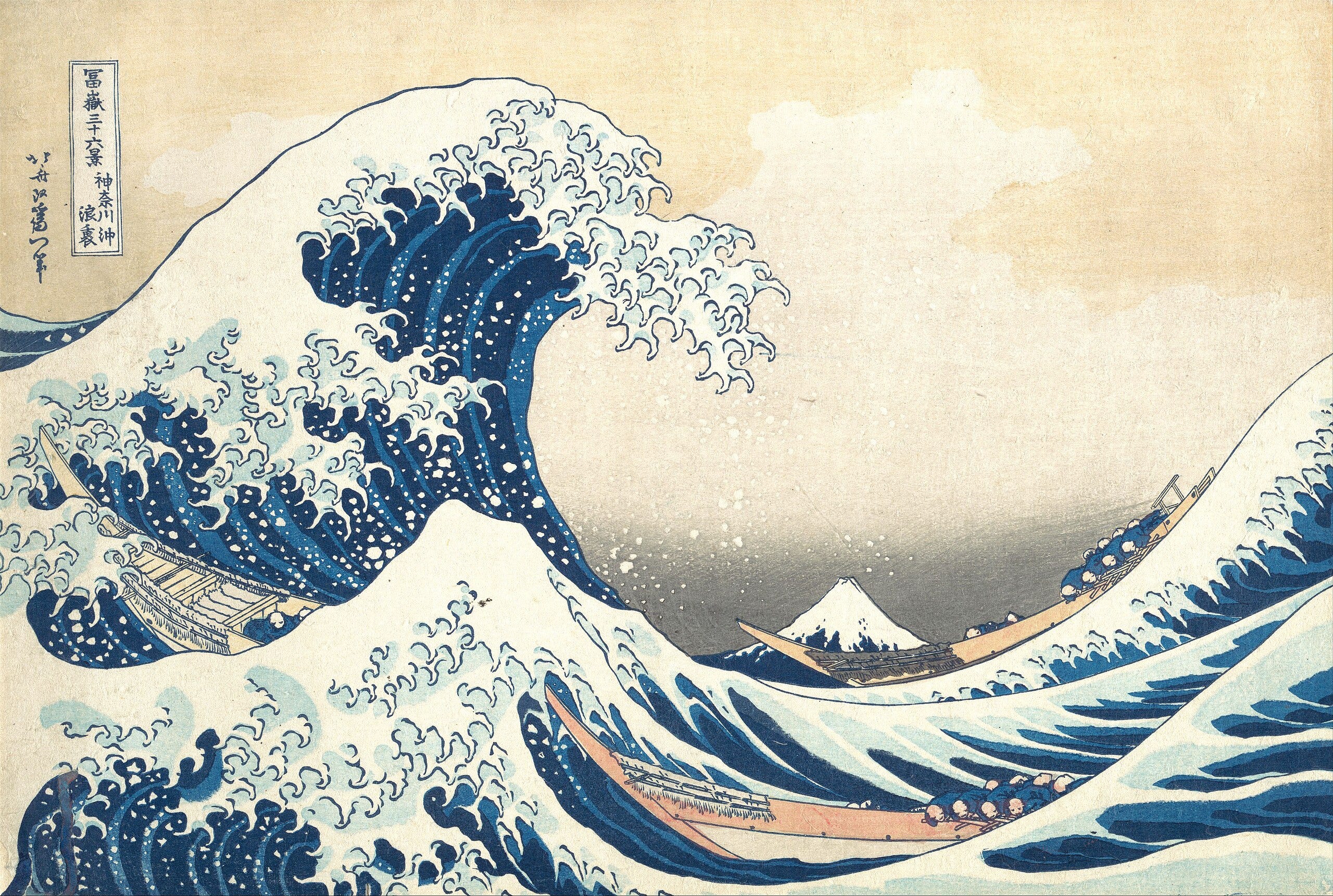
This essay’s “unrelated art that moves me” is Hokusai’s The Great Wave off Kanagawa which recently sold for around $2.8 million on auction.
Piece II: The Great Wave off Kanagawa by Katsushika Hokusai
A medical student? Yikes! Glad you found your way to where you are. You're made for it!