
On Raging Against
Or, why we continue to write and publish, despite.

I was doing an interview recently with the lovely people at pageturners.co.za when I was asked why I started Mirari Press. To be more precise, I was asked what my ‘why’ is – the interviewer a veritable Simon Sinek probing into my very heart of hearts.
I decided to avoid answers like ‘a love of books’ or ‘contributing to the South African literary landscape’. These are true, of course – but they are true in the same way as saying you like nice food. The truth of those statements is so pervasive that they lose their meaning.
My maternal grandfather was an NG Kerk dominee – a Dutch Reformed minister – a devout and gentle man who seemed to have arrived at his convictions through hard work. His maxim, applied to more or less everything, was simple: leave things better than you found them.
That’s my why. Or at least, it’s the closest I’ve come to articulating one that holds up. I started Mirari Press because South African speculative fiction deserved a press that treated it seriously, and I thought I could be the person to do that. The leaving-better principle, applied to a gap in the literary landscape.
But here’s the thing – and it’s what this essay is actually about. That answer only works in retrospect. It’s a very tidy explanation for something that, in the living of it, has been considerably messier. And the gap between the neat retrospective answer and the daily reality of the work raises a more uncomfortable version of the question: not why did you start, but why do you keep going?
We’re culturally trained to explain creative and intellectual work in terms of outcome. The outcome might be financial, reputational, or social – it might even be as principled as my grandfather’s maxim. These outcomes are real. They’re also, in the economy of actual practice, insufficient. Most books made by small presses don’t recoup their origination costs in the first year (in fact, I’m willing to bet that most never do). Authors spend years writing masterpieces only for the work to vanish into the primordial ooze of the world’s content churning machine (there were more than 4 million books published in the US in 2025. Just the US.). The outcome-based account of why we do this (this being writing and publishing) breaks down almost immediately under the weight of what the work actually demands.
So the question needs reformulating.
The retrospective why
The error in asking “why do you do this?” is grammatical as much as philosophical. The question assumes that purpose precedes action – that the reason for making something exists prior to the making and propels it forward. In most domains, this is a useful fiction. In creative work, it almost never describes how things actually proceed.
I didn’t really know why I wanted to run a small press until I’d run it for a year. I didn’t know what Vespers of Tassari, the book I’m writing, was actually about until I’d written two hundred thousand words of failed drafts. The answer to why arrives after the fact, by which point it’s become indistinguishable from the work itself. Purpose, in this domain, is retrospective. It’s what you find at the end of the path and understand, finally, to have been the destination.
This isn’t a romantic idea. The ‘why’ can’t be front-loaded because the work is the process of discovering it. You don’t know what you think about secondary-world magic systems until you’ve spent months building and rebuilding one. You don’t know what kind of publisher you are until you’ve acquired six or seven books and started to see what they have in common. The coherence of a practice – its ‘why’ – is not a premise. It’s an emergent property.
Camus and the small press
Albert Camus argued, in The Myth of Sisyphus, that the fundamental philosophical question is whether life – understood as absurd, as fundamentally without inherent meaning – is still worth living. Sisyphus rolls his boulder to the top of the mountain. It rolls back. He descends and begins again. The repetition is eternal, purposeless, and fully understood by the man performing it. Camus’s conclusion is that we must imagine Sisyphus happy. Not despite the absurdity. Because of it. The revolt against meaninglessness is itself the point.
My grandfather would not have been a Camusian. He had, I suspect, a fairly clear account of where meaning came from, and it wasn’t from existential revolt. But bear with me, because I think they’re less far apart than they seem.
I’ve been thinking about Camus in relation to small press publishing for a while, because the conditions fit rather well. We know, with uncomfortable precision, what the numbers look like. We know that 821 copies must sell before a press breaks even on a single title, and that most locally published South African books don’t reach that in their first year (or perhaps ever). We know distribution is uneven, infrastructure is limited, and the readership is fragmented across geography, language, and access in ways that publishers in larger markets simply don’t face. There’s no version of this where the economics improve dramatically if we just work harder.
And yet the presses continue. The books get made. The novels get written.
I’m not making a virtue of difficulty – that would be exactly the kind of false romanticism I want to avoid. I’m pointing at something structural. The persistence of creative work in conditions where the outcome-based justification repeatedly fails isn’t explicable by the outcome-based world-view. It requires a different one. The Camusian view is: the continuing is the answer. The ‘why’ is enacted rather than articulated. Sisyphus doesn’t have a reason. He has a practice (There’s something deeply Buddhist here too, but I’ll leave that for another time).
And my grandfather’s maxim, looked at again, is not so different. Leave things better than you found them is not a promise of reward. It tells you nothing about what you’ll get back. It tells you everything about how to face the work.
Making as a form of knowing
There’s a third angle on this, which is less philosophical and more craft-specific. It has to do with what making things actually does to your thinking.
When I’m writing I find out things I didn’t know. This is familiar to most serious writers, and it doesn’t get less strange with repetition. Many an author will tell you how a character surprised them, or insisted on going somewhere the author hadn’t planned. This sounds absurd to those who do not write, and sounds exactly right for those who do.
Building a fictional world with coherent geography, economics, theology, and magic places demands on the imagination that thinking in the abstract simply doesn’t. You can’t worldbuild by deciding, in advance, what your world believes. You build the land first, ask what it produces, ask who controls that production, and follow the chain of consequence until a culture emerges that you didn’t plan and couldn’t have planned. The world teaches you what it is.
Publishing works the same way. Acquiring and editing half a dozen books in the same genre teaches you things about that genre that no amount of critical reading delivers in the same form. The practice is epistemically productive. It generates knowledge that’s simply unavailable to non-practitioners.
This, I think, is the most honest account of the ‘why’ – though it’s compatible with both the Camusian and my grandfather’s answer. The making of things is a way of knowing that has no adequate substitute. You do it because it tells you things. It changes your mind in specific and unforeseeable ways. It makes you a different thinker than you would have been otherwise.
That’s not the same as saying it makes you a better person, or that it’s good for the culture, or that it contributes meaningfully to literature. Those things may or may not be true. They’re not the why. The why is epistemic. You make things because you have to. Something inside you insists you continue the practice, despite all the odds, because there is knowledge to be had.
The wrong question, finally
When I was asked why I started Mirari Press, my grandfather’s maxim arrived almost automatically. Leave things better than you found them. It’s a good answer. It’s also, I now think, only part of one.
The fuller answer is that I didn’t completely know why until I’d been doing it for quite some time – until I’d made enough mistakes, published enough books, and written enough failed drafts to understand what the work was actually teaching me. The ‘why’ wasn’t waiting for me at the beginning. It accumulated. It has, of course, not fully arrived yet either. Sisyphus would be proud. The work continues.
My grandfather applied his maxim to his parish, his family, his farm, the particular corner of the world he’d been given to tend. He was not, as far as I know, a man racked by existential uncertainty about whether it was worth tending. He just tended.
There’s something in that which is more useful to me than any philosophical framework, including Camus’s – though Camus gets you there eventually too. The work doesn’t need a reason that precedes it. It needs someone willing to stay with it long enough to find out what it’s for.
That, frustratingly, is not a reason. It’s an invitation. And the only way to understand it is to begin.
ARS CULTURA
Here’s what I’ve been watching, reading, and getting dressed up for.
Series
Only three episodes into The Testaments, but I’m already riveted – and the timing is almost suspicious, given that I finished reading The Handmaid’s Tale only a few weeks ago. We’ve pressed pause on the show because I now want to read the book first. Atwood’s sequel is a denser, more structurally ambitious novel than its predecessor: three interlocking narrators, each with their own relationship to Gilead’s particular violence. The first three episodes of the show suggest the adaptation is honouring that complexity rather than flattening it for accessibility. Too early for a verdict. Check back in.
For fans of: Atwood, dystopia that verges on reality, persistent dread
Books
Project Hail Mary by Andy Weir gets a 4/5, which surprised me slightly – I went in expecting it to be twee, and found it to be charming. Weir’s science is wonderful, but what carries this book is the friendship at its centre, which he handles with an earnestness that could so easily tip into corny and somehow doesn’t. A lighter read than I usually reach for, and completely unashamed of that. Good.
For fans of: hard sci-fi, interspecies communication, crying about a rock
Kaila Yu’s Fetishized earns a 4/5 and is doing something I find genuinely difficult to pull off: it is angry and funny at the same time, and neither quality undercuts the other. Yu writes about being an Asian American woman with a sharpness that never tips into polemic. The essays build on each other in a way that feels almost novelistic, and by the end the cumulative weight of what she’s describing has landed somewhere that individual essays couldn’t have reached alone.
For fans of: essay collections, anyone who has ever been reduced to a single feature of themselves
I’m giving Gillian Flynn’s Gone Girl a 3/5, and I’m prepared to defend that. It’s a genuinely clever structural conceit – dual unreliable narrators, each dismantling the other – and Flynn executes the central mechanism with real skill. But I found the ending unsatisfying in a way that felt like a consequence of the book’s own logic catching up with it. When your entire architecture depends on both narrators being untrustworthy, the ending has to earn its landing. This one, for me, didn’t quite. Respected. Not won over.
For fans of: domestic noir, twist mechanics, arguing about endings in book clubs
And the Mirari note: Call the Fire by Nerine Dorman is our latest release. It’s book one in the Scatterlings of Fate series – an adventure fantasy that will have you squealing (and crying). It’s available for pre-order now, and will be available nationwide in the next few weeks.
Movies
A rewatch of the original Hunger Games trilogy reminded me how well those films hold up – better, I’d argue, than the franchise typically gets credit for. Jennifer Lawrence carries all three on her back, the Capitol production design has aged remarkably well, and the willingness to let the ending be genuinely bleak remains unusual for a YA adaptation at this scale. A comfortable 5/5, and I’m not embarrassed about it.
Our Son (2023), with Billy Porter and Luke Evans, is a harder film than its premise might suggest. It’s not a story about whether two gay men can be good parents – that question is never in doubt. It’s about how people who once loved each other do terrible, human things during the dissolution of that love, and how the child in the middle is not a symbol but a person. Porter in particular is doing some of his best screen work. 4/5.
Theatre
I gave Pretty Woman: The Musical at the Artscape a 5/5 and I will hear absolutely nothing about it. The staging was gorgeous, the leads exceptional, and even though I didn’t know the music, I was still enraptured. Sometimes the work of going to the theatre is precisely this: allowing yourself to be transported somewhere uncomplicated and beautiful for two hours, without apology. An utter delight.
Art
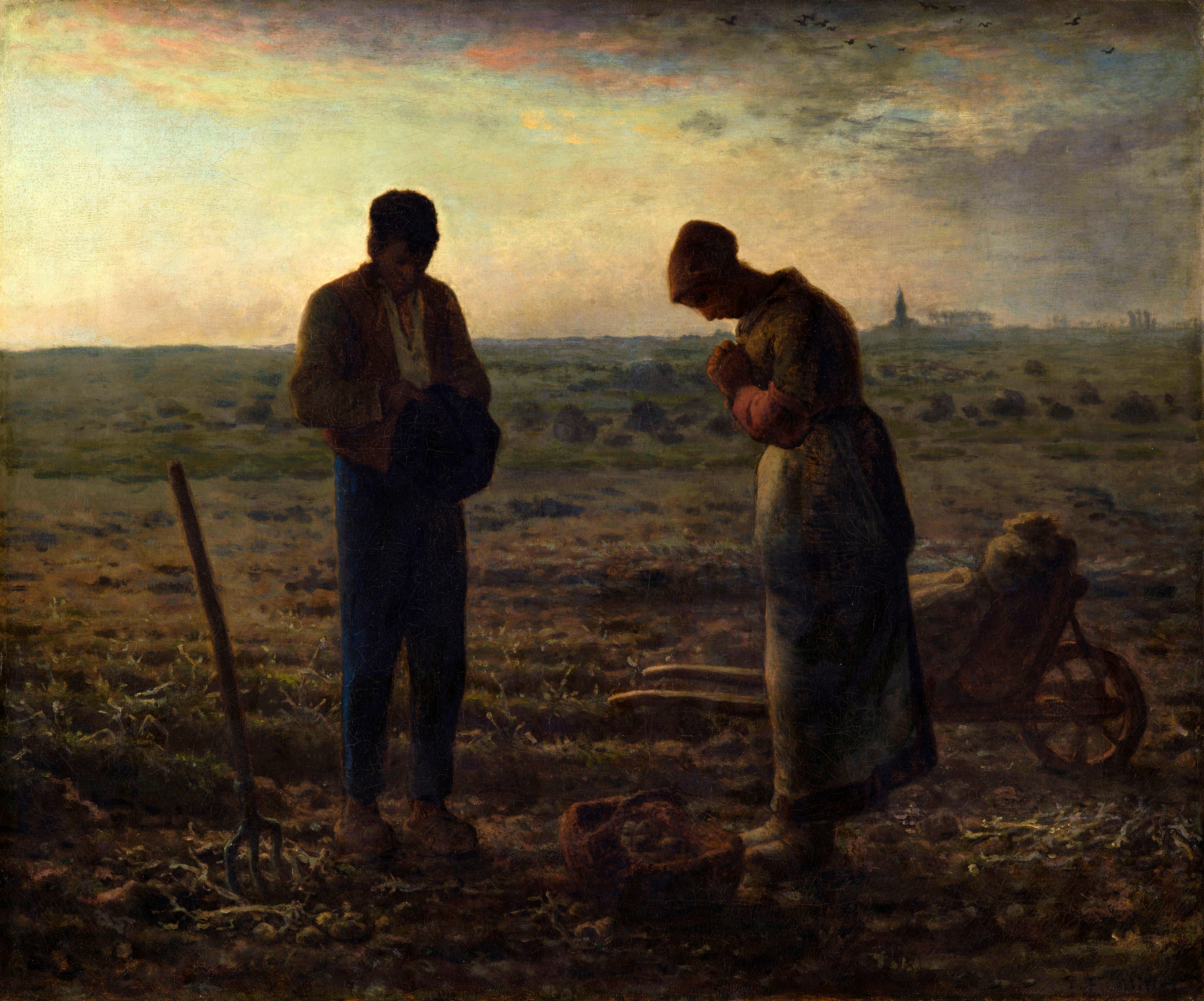
This essay’s “unrelated art that moves me” is Jean-François Millet’s The Angelus. Although I will confess that this one is, in fact, quite related to this essay:
Two peasant farmers pause in their field at the sound of the evening bell with heads bowed, tools lowered, and the day’s labour momentarily suspended in something that looks like prayer. The harvest basket sits between them. The work isn’t finished. They’ll return to it.
What I find most interesting about it in the context of this essay is what Millet doesn’t show us: we have no idea whether the harvest was good. We don’t know if it was worth it. The two figures have simply stopped, acknowledged something larger than themselves, and will continue. The ‘why’ is entirely interior. It never appears on the canvas.
Millet was, incidentally, deeply controversial in his time: accused of socialist propaganda for daring to paint working people with the same gravity previously reserved for saints. Which adds a small irony: a painting about humble, unglamorous persistence that was itself an act of stubborn artistic conviction.
This is a brilliant essay, M! Thank you x
Loved this! I also recently rewatched all the hunger games movies :)