
On Tesserae
Or, the value of small acts of creation

Tomorrow is the third instalment of Otherworld, the speculative fiction gathering held at Exclusive Books at the V&A Waterfront. I’ve been thinking about the previous two events, and it reminded me of a moment from last year during a panel discussion on publishing in South Africa (always a hot topic).
At some point between questions I stopped listening to myself talk (a skill I recommend, though I’m not that good at) and looked at the room instead: writers I have published, writers I have declined, readers holding local books they had paid local money for, booksellers on a Saturday shift doing the often-literal heavy lifting for this industry. A collection of individuals who, in their own small, every-day way, slowly build something bigger than all of us.
A tessera is the individual tile of a mosaic: a chip of marble, glass or stone, usually a few millimetres across. The Alexander Mosaic, excavated at Pompeii in 1831, is made of roughly 1.9 million of them.[1] Here is the detail I find most useful: no single tessera depicts anything. A fleck of Carrara white is not Alexander’s eye. A chip of Tunisian yellow is not a dying horse. The image exists only at the level of arrangement – in the decision to set this piece beside that one, a few million times over. And then to step back far enough to see what you have made.
In large publishing markets, the arrangement takes care of itself. There are so many presses, festivals, clubs and prizes that no individual tile carries any real sustaining value; remove one from a mosaic of millions and the picture does not really change all that much. In South African speculative fiction, the mosaic is small enough that we are not afforded that luxury. Which means every tessera carries disproportionate structural weight, and ‘supporting each other’ stops being a sentiment and becomes a description of how the image exists at all. Remove one tile here and there is a hole where part of the picture used to be.
So: I’d like to put down some tiles.
The Black Mail Club
Andrea Le Riche – author of the Little Sins series, the dark fantasy novella Aria of the Fallen, soon-to-be-published short story XIII: Death in the upcoming Major Arcana anthology, and founder of one of the country’s largest book-club communities – has built The Black Mail Club, a monthly poetry correspondence subscription. I was fortunate enough to sign on for the first edition.
Let me not put words in Andrea’s mouth. Here is what it is about:
In a world where so many literary subscriptions, collector clubs, and creative experiences seem to exist somewhere overseas, I wanted to create one right here at home. Every poem, letter, art print, and carefully chosen treasure is written, designed, and assembled by me in South Africa, then sent out into the world inside its signature black envelope.
The Black Mail Club is a celebration of storytelling, creativity, and the simple pleasure of receiving something unexpected in the post. And because I’m South African too, I know better than most that trusting something precious to the postal service can feel a little optimistic. That’s why I work with trusted local delivery partners to make sure your black envelope has the best chance of arriving safely at your door each month.
The joy of receiving a (beautifully made) letter full of ephemera is something I have honestly never experienced. I won’t tell you what’s inside, and I won’t post about the contents – for me, at least, I want to keep this sacred little moment offline.
I exhort you to subscribe here. It is a delight.
Otherworld
The gathering itself. Tanya Meeson (author of The Fulcrum, The Akashic Records of the Last People as Written by Neko and this year’s The Witch of Benbar’s Cross) and Shameez Patel Papathanasiou (author of The Last Feather portal fantasy trilogy, and romance bestsellers Playing Flirty and Next Level Love) created Otherworld in 2024 because, as far as anyone could tell, nothing like it existed in Cape Town. Three panels that first year, all full houses. A fourth panel added in 2025, also full. This year’s edition, hosted again at Exclusive Books Waterfront on 25 July, runs four panels on speculative fiction and publishing – free to attend, booked out through the Exclusive Books events page. For years the industry consensus held that there was little appetite for a local brew of speculative fiction. Otherworld’s third year and fullest line-up yet begs to differ.
Modjaji Books
Modjaji Books, Colleen Higgs’ independent press, has been publishing southern African women writers since 2007 and has been laying speculative tiles into its list without ever rebranding as a genre press. Shanice Ndlovu’s debut collection The Pride of Noonlay is the kind of book I mean, and at one point Modjaji had three authors on the NOMMO Awards longlist (the prize for African speculative fiction) in a single year. There is something instructive in a press doing genre work without needing the genre label: the list follows the writing, not the marketing category. (Regular readers will recognise this as the inverse of the problem discussed in On Forms.)
Fables at the Farmhouse
At the other end of the scale from a national prize: a heritage farmhouse in Welcome Glen, near Simon’s Town, a national monument restored and reopened as a community centre in 2025 after years standing derelict, recently hosted the first Fables at the Farmhouse, organised by spec-fic author extraordinaire Nerine Dorman. Fables at the Farmhouse is exactly the kind of tessera that never makes industry news and holds more of the picture together than most things that do: an individual, a room, an audience that walked there. Publishing likes to talk about ‘reader development’ as though it were a department, or a KPI deliverable. Mostly it is this – readers and writers sharing spaces to talk about what they love. I hope this becomes an annual thing.
My own tessera
It would be poor form to spend an essay arguing that the picture is made of small pieces and then decline to lay one of my own. So here is mine: the opening thousand-odd words of Paper Lantern Boys, my short story published in UTOPIA/HAVOC, the Mirari Press anthology.
Morning slips over Kyoto in layers of pale gold. Solar roofs glint beneath a mist that still smells of rain. In the eastern quarter, a lanternmaker’s workshop stirs, a half-lit enclave of cedar and the quiet hum of honest work.
Ren sits cross-legged at his bench, brush balanced between his fingers. The workshop is warm. Along the rafters, half a dozen Hibari drones drowse in their roosts, bronze pods no larger than sparrows, petals of solar film folded around their cores. As dawn brightens, they rouse, unfurling faint light like morning glories opening to the sun. Their low chimes hum through the room, soft as temple bells.
Ren draws a single kanji onto the lantern, 光, hikari, light, and breathes out as the ink spreads. Graphene filaments lace through the black; once the ink dries, the character fuses with the bamboo alloy ribs and becomes a micro-conductor within the city’s power web. Yet the motion of his hand is older than the circuitry it awakens, an artform passed down in his family from before the first solar flares.
Suzu bustles in from the back room, hair tied high, tablet glowing in her hand. “Audit day, Takayama-san,” she announces. “The city’s running Shiyoku rounds again. You should hide that old hand-made stuff. Or better yet, just join the rest of us in the twenty-second century and use the printed circuitry.”
Ren smiles without looking up. “And give up the simple pleasure of creation? No thank you.”
“The pleasure of paying fines, you mean.” She flips her visor to show a glowing alert: Municipal Shrine-Network Maintenance Division – Inspection Pending. Shiyoku Auditor Drone FP-294 assigned to Takayama Lanternmakers.
Ren rolls his eyes and returns to the lantern. He tests the frame, bamboo alloy ribs clicking softly. The paper skin catches the morning light and turns almost transparent. He inserts a filament of bio-crystal: the lantern’s heart. A pulse beats into his fingertips, the crystal emitting a faint glow where it touches him.
Ren has always been in awe of the myōkon, the tiny crystals grown like coral off the northern coasts. It was the myōkon that provided the framework for a sustainable transition from fossil fuels. Living light – that’s what people call it now. Biology and circuitry thinking together. Even after decades of handling them, Ren still feels reverent when the myōkon hums under his touch, as if it recognises the brushstroke of every artisan who ever shaped them.
Ren clips the myōkon into its cradle in the centre of the lantern. A soft pop confirms the seat. When the myōkon filament activates, the lantern blooms from within. For a moment something alive moves under his fingers. A tremor, faint but aware, as though the lantern is breathing beside him.
A soft shadow passes over the window lattice, long, graceful, feathered with light. Ren and Suzu both look up as the Shiyoku Auditor Drone descends through the morning mist like a heron of glass and gold. Its wings spread in precise geometry, each pane of solar film glinting with stored dawn. Beneath its body, a wind-chime node sings a single harmonic note as it stabilises above the bench. The Hibari hush instantly, their tiny petal-wings folding tight.
Ren lowers his brush. He has been audited a hundred times; a routine thing to protect the city from unsanctioned circuitry. But the new lantern is still warm at his elbow, and he finds he is angling himself between it and the heron without thinking. “All right,” he murmurs. “Do what you must, Auditor.”
The Auditor’s throat-lens blooms with a faint glow, casting a scanning halo that drapes across Ren’s table. Blue geometry unfurls a net of perfect lines, intersecting the paper where his fresh kanji still gleams wet.
Ren lowers his brush and slides his registry tablet into the grid’s light. The Auditor chirps once: Status: verified. Firmware sync in progress.
Ren relaxes fractionally. He returns to the new lantern and finishes the character’s final tail. The ink dries into a glossy seam, joining paper and alloy like bone and skin.
He whispers, almost to himself, “Intent still matters.”
“What was that?” Suzu asks.
“Nothing.”
The Auditor tilts its head, the halo narrowing. Its wing-feathers flare, mirrors catching the smallest shift in frequency. A chime rises from its body as it sends a questing signal into the myōkon core of the lantern Ren is working on. The lantern’s inner circuits answer with a pulse that makes the hanging workshop drones quiver.
“Ren…” Suzu warns.
He watches the myōkon brighten until it shines like a cold moon. Then the lantern sings: a single, clear tone that overwhelms the Auditor’s signal.
The Auditor’s song falters. Its wings ripple from amber to white, its circuitry struggling to interpret the anomaly. The lantern emits another single, clear note that hangs between the machines and the human hand that made it.
Every Hibari in the rafters lifts its head, chiming in sympathetic vibration. The whole room glows, soft and alive.
Alarms flash along the Shiyoku’s spine: Unauthorised conduction signature detected.
The lantern’s light washes through the workshop. The Hibari fold inward, extinguishing themselves, lights fizzle out, and the Shiyoku shuts down.
“Ren, what did you do?”
He wraps the lantern in a cloth, voice steady. “Nothing.”
“Nothing? That lantern just overrode a city drone.”
“Not if there’s no evidence.”
He reaches up and brushes his fingers across the Auditor’s side panel. The machine’s feathers flicker, confused; it emits a questioning trill. After a moment it steadies, projects a final verification pulse, and lifts back into the morning and disappears among the solar roofs.
Silence settles. The Hibari fold open and exhale a collective tone: relief, or mimicry of it.
Suzu exhales too. “Next time, just use the printed conduction text. And we need to get that lantern into the river so that the myōkon can reboot and fix whatever that was.”
“Yes, yes. This is the last of them. Let me go and wash up, then we can go and connect today’s lanterns to the network. Whatever happened with this one will be fixed once it’s been locked into the system.”
Ren unwraps the lantern. It beats once with faint gold, a living rhythm. Warmth lingers against his palm; it’s not the heat of artifice, no. Ren knows that heat. This is the warmth of life. He has touched a thousand myōkon and none of them have answered like this.
He traces the kanji and whispers, “What are you?” And then, more quietly, because he knows he should be afraid and isn’t: “What am I going to do with you?”
The paper trembles, as if the question itself stirs it. Then the light dims, folding into stillness.
Outside, bells begin to sound from the river quarter, calling the living to remember the dead for the Obon festival. Their tone drifts through the open door, bright and far.
Read the rest of Paper Lantern Boys, along with eight other brilliant stories, in UTOPIA/HAVOC, an anthology of stories about what the near future might look like.
From the last snow protea clinging to a dying mountain to the oceanic cities of a reborn Earth, UTOPIA/HAVOC traces humanity’s long arc through collapse, adaptation, and renewal.
In these stories, the end is never clean. The cities of tomorrow shimmer with both promise and ruin; technology becomes a god, a weapon, and a mirror. Lovers meet inside virtual heavens, rebels rise from the ashes of burnt-out empires, and new mythologies take root in the cracks of what was once civilisation.
You can get a copy here.
The arrangement
The Naples restorers found that the Alexander Mosaic’s tesserae came from everywhere: Carrara marble, Portuguese pink stone, yellow from a quarry in what is now Tunisia, dark red from a Greek cape. Someone gathered these tiny tiles across half a known world and set them down next to each other, on purpose, until a battle appeared.
Our mosaic is smaller and the quarries are closer together, but the mechanics are identical. A book club in Cape Town, a free gathering in a bookshop, a women’s press taking a chance on a story collection, a farmhouse in Welcome Glen, a short story in an anthology – none of these depicts a literary culture on its own. The picture only exists at the level of arrangement. So I encourage you to pick up your own tessera and add it onto the mosaic. Buy the ticket, join the club, show up at the farmhouse, read the local book. Once you see the landscape as tesserae, you can no longer mistake showing up in the industry as a ‘courtesy’ or a ‘preference’. It’s the grout that keeps the whole thing together.
ARS CULTURA
Here’s what I’ve been reading and watching.
Books
I finished Douglas Stuart’s John of John. A young artist, John-Calum Macleod, retreats home to the Isle of Harris after failing to launch, and walks straight into his father’s expectations and the family’s buried history.
4/5 stars from me, and I suspect the missing star says more about me than the book: I loved Shuggie Bain and Young Mungo so completely that anything set outside their shadow was always going to be measured against it.
For fans of: Shuggie Bain, the Outer Hebrides, fathers and sons not saying the thing, crying in a manner you will describe as ‘fine’.
Series
We’re watching the fifth and final season of The Boys, which brings the Butcher–Homelander arms race to its long-promised conclusion. The first four seasons all managed to genuinely repulse me. The fifth is turning out to be so close to what is happening in America right now, that I can’t look away.
For fans of: superheroes behaving abominably, satire with the safety off, Karl Urban saying a certain word.
Theatre
We went to the Artscape for the Cape Town Gilbert & Sullivan Society’s The Pirates of Penzance with a cast of more than sixty, the newly formed 26-piece Cape Town Sinfonietta in the pit, and every patter song landing at speed. There is something moving about a comic opera from 1879 filling a Cape Town theatre in 2026 on the strength of a volunteer society and a very modern Major-General (who was 100% the show-stealer).
Art
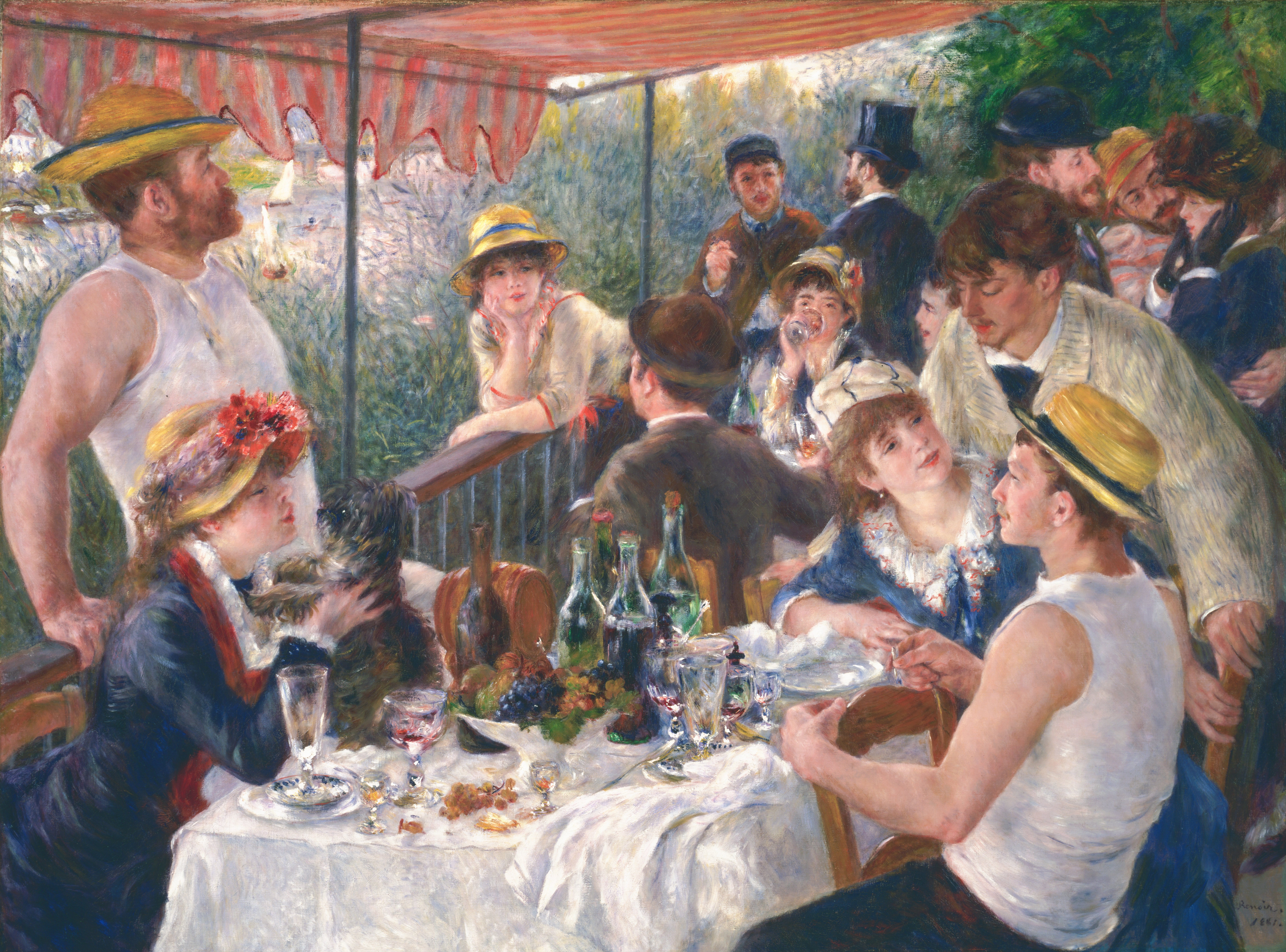
This essay’s ‘unrelated art that moves me’ is Pierre-Auguste Renoir’s Luncheon of the Boating Party (1880–1881), now in the Phillips Collection in Washington. Fourteen people and a dog at a riverside table each absorbed in their own conversation, none of them aware they are being held together by the composition.
[1]The count comes from the mosaic’s 2020–2025 restoration programme, published in PLOS ONE in January 2025 (From tiny to immense: Geological spotlight on the Alexander Mosaic). Older estimates ran as high as four million; I am siding with the people who pointed X-ray fluorescence machines at it.
This was so beautiful to read. I struggle so much with zooming out, spending too much time hyper-fixating on the little details - I’ll carry this metaphor with me forever 🖤
I love the idea of us all bringing our small bits of creation together to form a whole.